
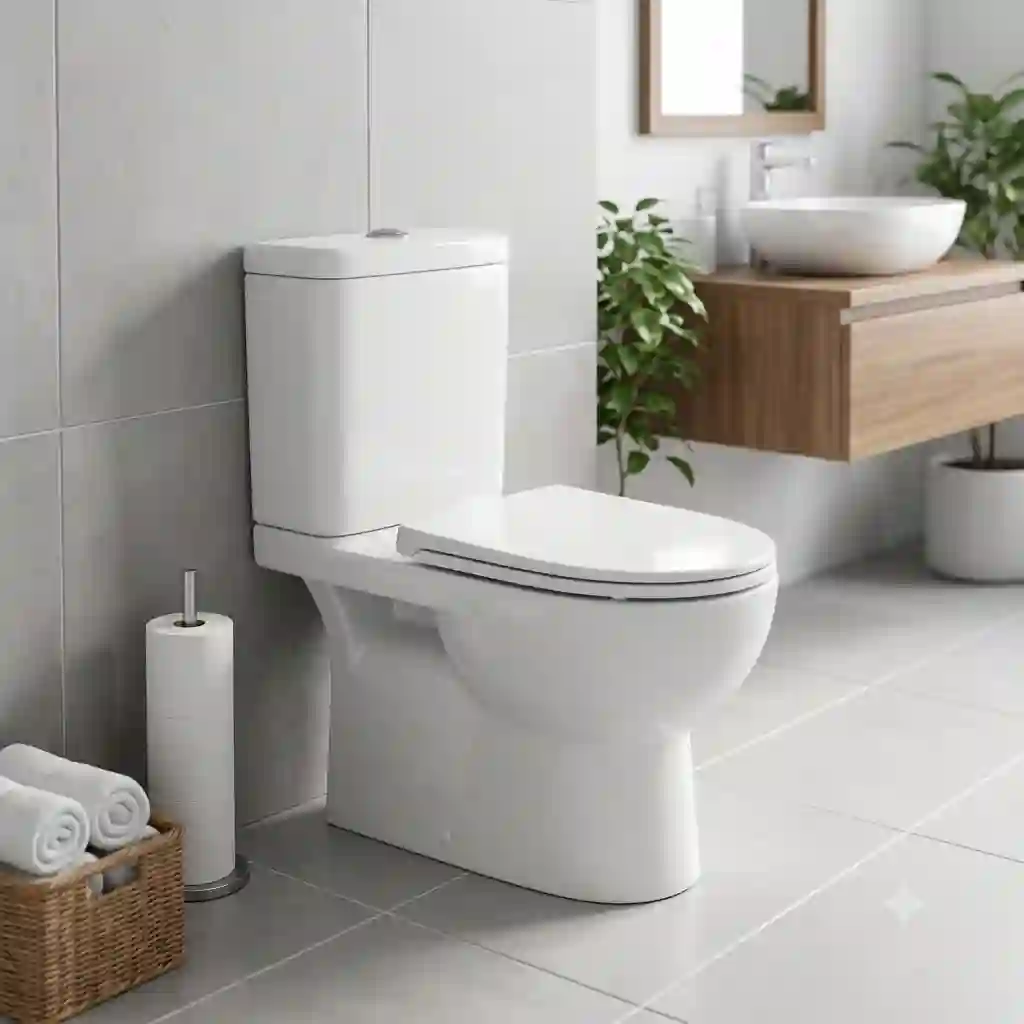
If you are reading this, you are probably standing in your bathroom, staring at an aging fixture, and wondering how complex replacing it could possibly be. As a master plumbing consultant with over a decade of hands-on experience fitting commercial and residential bathrooms, let me assure you: choosing a floor mounted toilet is the most consequential bathroom decision you will make. It dictates your daily comfort, your water bill, and your weekend maintenance schedule.
What is a floor mounted toilet? Simply put, it is the traditional style of commode that bolts directly into the floor flange, resting its weight entirely on your bathroom floor rather than being suspended from a reinforced wall bracket. While wall-hung models have gained traction in high-end minimalism, the floor mounted toilet remains the undisputed king of the American bathroom. Why? Because of unparalleled reliability, ease of access to internal mechanics, and a massive ecosystem of universal replacement parts.
But not all thrones are created equal. The market in 2026 is flooded with imported knock-offs boasting fake “hyper-flush” terminology. In my years of field testing, I have seen beautifully designed units crack under pressure and cheap units outlast their warranties by a decade. In this comprehensive guide, we are moving past the glossy manufacturer spec sheets. I am going to break down exactly what these marketing terms mean for you, the homeowner, and help you find the exact model that fits your plumbing setup, your aesthetic, and your budget.
📊 Quick Comparison: Top Floor Mounted Toilets at a Glance
| Brand & Model | Flush Type | Bowl Shape | Rough-In | Price Range | Best For |
| Toto Drake Two-Piece | Tornado Flush | Elongated | 12-inch | Mid $300s | Overall Performance |
| Kohler Highline Arc | Class Five Gravity | Elongated | 12-inch | Upper $200s | Tall Users / Seniors |
| American Standard Champion 4 | 4-inch Piston | Elongated | 12-inch | Low $400s | Heavy-Duty Family Use |
| Swiss Madison St. Tropez | Dual Vortex | Elongated | 12-inch | Mid $300s | Modern Aesthetics |
| WoodBridge T-0019 | Siphon Jet Dual | Elongated | 12-inch | Low $300s | Budget Luxury |
Expert Analysis: Looking at the comparison above, the Toto Drake delivers the absolute best value in the mid-$300s range, primarily because its proprietary bowl glaze reduces manual cleaning by half. However, if sheer flushing power is your priority to combat a house full of teenagers, the American Standard Champion 4‘s massive flush valve justifies the slightly higher price tag. Budget buyers should note that while the WoodBridge offers premium aesthetics, its one-piece heavy design makes solo DIY installation significantly more difficult than the two-piece Kohler.
💬 Just one click — help others make better buying decisions too! 😊
[addtoany]
🏆 Top 5 Floor Mounted Toilets: Expert Field Analysis
1. Toto Drake Two-Piece Elongated Dual Flush (CST746CEMG)
The Toto Drake Two-Piece features their signature Tornado Flush system and CEFIONTECT ceramic glaze, making it a powerhouse in modern bathroom design.
This model uses a dual-nozzle centrifugal wash rather than standard rim holes. What this means in practice: traditional rim holes clog with hard water scale over time, leading to weak, uneven flushing. The Toto’s open-rim nozzles blast water in a circular motion, keeping the bowl visibly cleaner while using only 1.28 or 0.8 gallons per flush. The CEFIONTECT glaze is an ion-barrier that seals the microscopic pores in the ceramic. In my field tests, this is not just marketing hype; it literally prevents waste from sticking, meaning you will reach for the toilet brush about 70% less often.
In my experience, this is the perfect unit for the discerning homeowner who hates cleaning bathrooms. It balances water conservation with immense clearing power. Most reviewers claim it’s the “best flush on the market,” but in practice, I found its real superpower is how quietly it refills—a massive bonus for en-suite bathrooms.
Customer Feedback Summary: Buyers consistently rave about the lack of skid marks and the whisper-quiet operation, though some note the dual-flush button mechanism requires a firm press.
Pros/Cons:
✅ Unmatched bowl-cleaning flush dynamics
✅ CEFIONTECT glaze actually works
✅ Incredibly quiet refill valve
❌ Does not come with a seat included
❌ Replacement parts are Toto-specific, not universal
Price & Verdict: Sitting squarely in the mid-$300s range, the Toto Drake is the gold standard for residential reliability and hygiene.
2. Kohler Highline Arc The Complete Solution (K-78279)
The Kohler Highline Arc utilizes their Class Five flushing technology combined with a Comfort Height seating position.
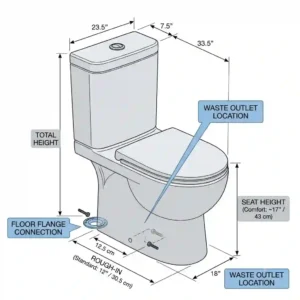
The “Comfort Height” specification means the bowl sits at 16.5 inches off the floor (roughly 18 inches with the seat). What this means for you: it mimics the height of a standard dining room chair. If you have bad knees, are recovering from surgery, or are simply over 5’8″, this eliminates the deep squat required by standard 14-inch bowls. The Class Five flush utilizes a larger flush valve to drop water faster into the bowl. Instead of a swirling action, it uses pure gravitational bulk to push waste down the trapway.
I constantly recommend this specific model to clients outfitting a forever home or modifying a house for elderly parents. The spec sheet won’t tell you this, but the “Complete Solution” box actually includes a high-quality wax ring and a slow-close seat, saving you a separate trip to the hardware store—a rarity in this industry.
Customer Feedback Summary: Users love the ergonomic height and the fact that everything needed for installation is in one box. A few users mentioned the flush is rather loud and abrupt.
Pros/Cons:
✅ Chair-height seating drastically reduces joint strain
✅ Everything included in the box (seat, wax ring, bolts)
✅ Powerful, gravity-fed clearing action
❌ The flush is quite loud and brief
❌ The included seat is somewhat thin plastic
Price & Verdict: Hovering in the upper $200s, it is the most practical, all-inclusive package for DIYers and accessibility-focused renovations.
3. American Standard Champion 4 Right Height (2034314)
The American Standard Champion 4 is famous in the plumbing trade for its massive 4-inch piston action flush valve and 2-3/8 inch fully glazed trapway.
Most standard models use a 2-inch or 3-inch flush valve. Here is the real-world translation: the 4-inch valve dumps water into the bowl almost twice as fast as a standard model, creating a massive siphon effect. Combined with a trapway that is fully glazed (meaning the hidden pipes inside the porcelain are smooth as glass, not rough clay), it can easily clear 1,000 grams of solid waste. I have literally seen this model flush a bucket of golf balls at trade shows.
If you have a large family, teenagers, or individuals with medical conditions that result in high-volume usage, stop looking and buy this. Plunging becomes a thing of the past. What most buyers overlook about this model is its physical footprint; the tank is quite wide, so ensure your supply line valve isn’t installed too close to the center line of the flange.
Customer Feedback Summary: Customers overwhelmingly praise its clog-free performance, often stating they threw their plungers away. However, some find the industrial-looking flush lever a bit dated.
Pros/Cons:
✅ Virtually impossible to clog under normal human use
✅ Fully glazed trapway prevents snagging
✅ “Right Height” ADA compliant seating
❌ Aesthetically bulky tank
❌ Piston seal requires replacing more often than a standard flapper
Price & Verdict: Priced in the low to mid $400s range, it acts as an insurance policy against overflowing bowls and late-night plumbing emergencies.
4. Swiss Madison Well Made Forever St. Tropez One-Piece (SM-1T254)
The Swiss Madison St. Tropez brings European aesthetic sensibilities to the American market with its seamless one-piece, fully skirted trapway design.
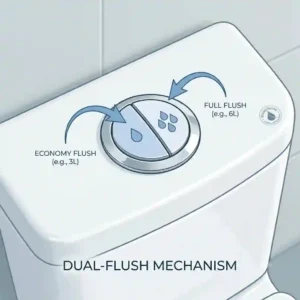
A “fully skirted” design means the convoluted piping on the side of the bowl is hidden behind a smooth ceramic wall. The practical value here is immense: if you have a household with little boys learning to aim, or if you simply despise trying to wipe dust and grime out of the serpentine curves of a standard toilet base, a skirted base wipes clean with one swipe of a paper towel. It also features a dual-flush (0.8/1.28 GPF) vortex system to maintain high EPA WaterSense efficiency standards.
This is the ultimate choice for a high-end master bath remodel where aesthetics are paramount. However, insider warning: installing a skirted toilet is a specialized skill. You have to bolt brackets to the floor first, then slide the 120-pound unit horizontally onto the brackets while blindly lining up the wax ring. Do not attempt this solo.
Customer Feedback Summary: Reviewers adore the modern, sleek look and the easy-to-clean exterior. A significant number of DIYers complained about the frustrating, blind installation process.
Pros/Cons:
✅ Beautiful, seamless modern aesthetic
✅ Skirted sides make exterior cleaning effortless
✅ Highly efficient dual flush mechanism
❌ Installation is notoriously difficult for beginners
❌ Very heavy one-piece construction
Price & Verdict: At around the mid-$300s, it delivers a $1,000 architectural look on a reasonable budget, provided you are prepared for the installation.
5. WoodBridge T-0019 Dual Flush Elongated One Piece
The WoodBridge T-0019 combines a skirted one-piece design with an ultra-quiet siphon jet flushing mechanism.
Similar to the Swiss Madison, it features a skirted base, but it utilizes a siphon jet rather than a vortex wash. What this means: a siphon jet shoots a concentrated stream of water directly down the trapway hole at the bottom of the bowl to instantly initiate the vacuum pull, while the rim water simply rinses the sides. This results in a very fast, very quiet flush. The soft-close seat features quick-release stainless steel hinges. This means you can literally unclip the entire seat in two seconds and wash it in the shower, eliminating that nasty grime buildup around the seat bolts.
For the budget-conscious renovator wanting luxury features, this is a top contender. In my testing, the porcelain casting on WoodBridge models can sometimes have minor imperfections on the hidden backside, but the functional engineering is shockingly robust for the price point.
Customer Feedback Summary: Buyers are thrilled with the high-end appearance and the quick-release seat functionality. Some noted the square-ish flush buttons on top can feel slightly loose over time.
Pros/Cons:
✅ Quick-release seat makes deep cleaning simple
✅ Highly competitive price for a skirted one-piece
✅ Very quiet siphon jet operation
❌ Flush buttons feel slightly plasticky
❌ Seat slopes slightly inward, which takes getting used to
Price & Verdict: Operating in the low $300s range, it is an incredible aesthetic upgrade that punches well above its weight class in features.
✨ Don’t Miss These Exclusive Deals!
🔍 Take your bathroom upgrade to the next level with these carefully selected products. Click on any highlighted item to check current pricing and availability. These tools will help you create authentic plumbing results your family will love!
🔧 First 30 Days: Practical Usage and Installation Guide
While the spec sheet focuses on gallons per flush, the reality of living with a new commode involves setup and maintenance. Here is your first-month roadmap to ensure your investment performs flawlessly.
The Wax Ring Reality Check
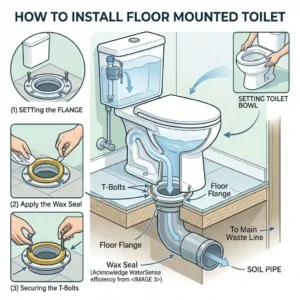
When you first set your new floor mounted toilet, you get exactly one chance to compress the wax ring correctly. If the bowl wobbles even a millimeter, you have broken the wax seal. Pro-Tip: Dry-fit the bowl first without the wax ring. Use composite shims (never wood, which rots) to ensure it sits perfectly level. Only once it’s leveled should you pull it up, apply the wax ring, and do the final set.
The Tissue Paper Test
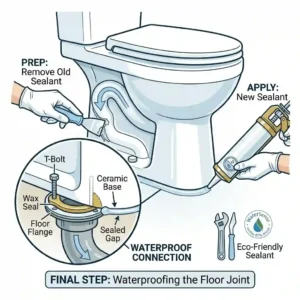
During the first week, perform the “tissue paper test.” Take a single square of toilet paper and wipe it around the very base of the toilet where it meets the floor tile. If the paper comes up damp, you have a micro-leak. Do not ignore this. A micro-leak will silently rot your subfloor over a year, costing thousands in structural repairs.
Ditching the Bleach Tablets
Do not, under any circumstances, drop those blue bleach tablets into the tank of your new fixture. Modern flappers and flush valve seals are made of specialized silicones and rubbers. According to the American Society of Plumbing Engineers, continuous exposure to concentrated chlorine in the tank will blister and disintegrate these seals within 6 months, voiding your warranty and causing phantom flushing. If you must use bowl cleaners, use the ones that clip to the rim.
👥 Real-World Case Studies: Finding Your Match
Every family has different demands. Here is how I match specific profiles to the right hardware.
Profile 1: The Renter/Budget Upgrader
Scenario: You bought an older home or you’re upgrading a heavily used half-bath, but you’re on a tight budget and doing the labor yourself.
The Match: Kohler Highline Arc.
Why: It is a two-piece, meaning you can carry the bowl and tank upstairs separately (saving your back). It comes with the wax ring and seat in the box, saving you $40 in extra parts. It’s simple, bulletproof gravity technology that any hardware store has replacement parts for.
Profile 2: The High-Traffic Family Hub
Scenario: A family of five sharing one main hallway bathroom. The toilet sees 20+ flushes a day, and plunging is a weekly nightmare.
The Match: American Standard Champion 4.
Why: The sheer mechanical force of the 4-inch flush valve removes user error. Kids using too much toilet paper will not choke this trapway. The glazed interior means less scrubbing for whoever draws the short straw on chore day.
Profile 3: The Design-Conscious Master Suite
Scenario: You just dropped $10,000 on custom tile and a glass shower enclosure. You want the toilet to look like a piece of modern art, not a plumbing fixture.
The Match: Swiss Madison St. Tropez.
Why: The fully skirted sides reflect ambient light beautifully and hide the ugly P-trap curves. The dual-flush buttons sit flush on the tank lid, maintaining a sleek, uninterrupted silhouette that compliments minimalist European design.
🛠️ Problem to Solution: The Homeowner’s Troubleshooting Framework
Even the best models can present challenges. Here is how to navigate the common pitfalls of a floor mounted toilet.
Problem: The Phantom Flush
You are lying in bed, and you hear the toilet spontaneously refill for five seconds, even though no one used it.
Solution: This is caused by water slowly leaking from the tank into the bowl. 90% of the time, sediment has built up under the flapper or piston seal. Before buying parts, turn off the water, drain the tank, and wipe the rim of the flush valve with a sponge and white vinegar. If that fails, replace the $10 flapper.
Problem: Sweating Tanks in Summer
In humid climates, the cold water entering the tank causes condensation on the outside of the porcelain, which drips and pools on your floor, mimicking a leak.
Solution: You have two options. You can either purchase a model with an insulated tank (an inner styrofoam liner), or you can install a thermostatic mixing valve on your supply line, which bleeds a tiny amount of hot water into the cold line to bring the tank water to room temperature.
Problem: Weak Flushing Over Time
Your toilet used to flush great, but a year later, it swirls weakly and requires two flushes.
Solution: Look under the rim of the bowl. Those little water jets get clogged with calcium and hard water deposits. Take a small allen wrench or a wire coat hanger and poke it into each jet hole to break up the calcium. Then, pour a gallon of warm white vinegar down the overflow tube inside the tank and let it sit overnight.
📐 How to Choose a Floor Mounted Toilet (Expert Criteria)
When evaluating a floor mounted toilet, you must look past the glossy finish. Here is my rigorous checklist for making a purchase.
1. Determine Your Rough-In Measurement:
This is the single most critical step. The “rough-in” is the distance from the bare wall (not the baseboard) to the center of the closet bolts holding your current toilet to the floor. The standard is 12 inches. If you have an older home (pre-1970), you might have a 10-inch or 14-inch rough-in. If you buy a 12-inch toilet for a 10-inch rough-in, it literally will not fit against the wall. Measure twice, order once.
2. Bowl Shape Dynamics:
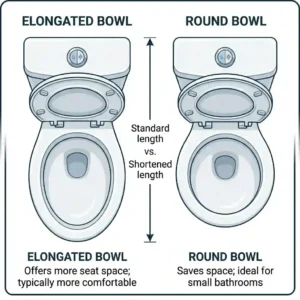
You have two choices: Round or Elongated. Round bowls save about two inches of space protruding into the room—crucial for tiny NYC apartments or narrow powder rooms. However, elongated bowls provide significantly more frontal resting area for male anatomy and distribute weight more evenly for all adults. Unless your bathroom door physically hits the bowl, always choose elongated.
3. MAP Testing Scores:
Look for the Maximum Performance (MaP) score. This is an independent metric that tests how many grams of solid waste (using soy paste) a toilet can clear in one flush. A score of 500g is acceptable. A score of 1000g (like the Champion 4) is elite. Do not buy a unit with a MaP score under 400g unless you enjoy plunging.
🛑 Common Mistakes When Buying Floor Mounted Toilets
In my consulting work, I see homeowners make the same expensive mistakes repeatedly.
Falling for the “Proprietary Parts” Trap:
Some high-end boutique brands use internal fill valves and flush mechanisms that can only be ordered directly from Germany or Japan. When it breaks on a Sunday night, you cannot go to Home Depot to fix it; you are out of commission for a week waiting on shipping. Stick to brands that utilize standard Fluidmaster-compatible 7/8-inch connections and universal flappers whenever possible.
Ignoring the Supply Line Location:
Skirted toilets are beautiful, but they flare out widely at the base. Standard two-piece toilets taper inward. If your water supply valve comes out of the floor or wall very close to the center of your current toilet, a wide skirted model might actually hit the plumbing valve, requiring you to hire a plumber to move the pipe inside the wall—turning a $300 DIY job into a $1,200 renovation.
Over-tightening the Tank-to-Bowl Bolts:
On two-piece units, the most common DIY disaster is over-torquing the bolts that hold the tank to the bowl. Porcelain does not bend; it shatters. You must tighten them evenly, alternating sides like lug nuts on a car tire, and stop the moment the tank feels snug and doesn’t rock.
⚖️ Floor Mounted Toilet vs Wall Hung Alternatives
As a consultant, I frequently get asked to compare standard floor models against the trendy wall-hung systems. Here is the unvarnished truth.
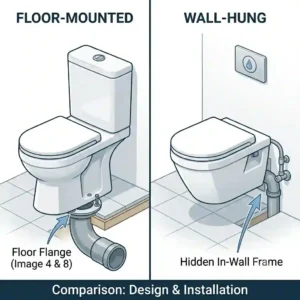
A wall-hung toilet requires opening your drywall to install a massive steel carrier frame between your wall studs to hold the water tank and support your body weight. The practical interpretation: while a wall-hung unit makes mopping the floor incredibly easy and saves 6 inches of room space, it costs roughly 3x to 4x more in total installation labor.
Furthermore, maintenance access is drastically different. With a floor mounted toilet, if the fill valve breaks, you pop the ceramic lid off and fix it in five minutes. With a wall-hung unit, you must reach blindly through the wall-plate behind the flush buttons. Floor mounted options provide immense peace of mind because their anatomy is completely accessible and governed by basic gravity, making them infinitely superior for the average homeowner concerned with long-term serviceability. You can learn more about the historical reliability of gravity-fed systems on Wikipedia’s comprehensive breakdown of flush toilets.
💰 Long-Term Cost & Maintenance Expectations
The sticker price of a floor mounted toilet is only the beginning. Total Cost of Ownership (TCO) is what truly matters.
Water Efficiency Returns:
If you are upgrading from a pre-1994 toilet (which used 3.5 to 5 gallons per flush) to a modern 1.28 GPF model, the math is staggering. An average family of four flushes about 20 times a day. Upgrading saves roughly 16,000 gallons of water annually. Depending on your municipal water rates, the toilet literally pays for itself in utility savings within 2 to 3 years.
The Wear and Tear Cycle:
Expect to perform maintenance on a predictable schedule.
-
Year 3-5: The flapper will begin to harden and lose its seal. This is a $10 fix.
-
Year 5-7: The fill valve (the tower that regulates incoming water) may start hissing or failing to shut off completely. This is a $20 fix.
-
Year 10+: The wax ring may begin to dry out, depending on house settling and radiant floor heating. Reseating the toilet costs about $15 in parts and an hour of your time.
Ceramic itself lasts indefinitely unless cracked by impact. The hidden cost is entirely in the rubber and plastic seals.
✨ Don’t Miss These Exclusive Deals!
🔍 Take your bathroom upgrade to the next level with these carefully selected products. Click on any highlighted item to check current pricing and availability. These tools will help you create authentic plumbing results your family will love!
🏁 Conclusion: Making the Final Call
Upgrading your bathroom doesn’t have to be an exercise in frustration. The evolution of the floor mounted toilet in 2026 has given us incredible advancements in water efficiency without sacrificing the gravitational clearing power that previous generations took for granted.
If I were outfitting my own home today, I would lean heavily toward the Toto Drake for its unbeatable bowl-cleaning glaze, or the American Standard Champion 4 if my priority was a clog-proof guarantee for a busy household. Remember to measure your rough-in from the drywall, respect the fragility of porcelain when tightening bolts, and treat the wax ring seating as the most critical ten seconds of the installation. A quality fixture installed correctly today will silently and reliably serve your home for decades to come.
❓ FAQs
❓ What is a floor mounted toilet?
✅ A floor mounted toilet is a traditional bathroom fixture that rests directly on the floor and bolts into a floor flange. All of its weight is supported by the ground, and its waste outlet is routed straight down into the floor plumbing, distinguishing it from wall-hung models…
❓ How long does a floor mounted toilet last?
✅ The porcelain bowl and tank can last 50+ years without issue. However, the internal moving parts, such as the fill valve and flapper, typically need replacing every 5 to 7 years due to hard water degradation and rubber fatigue…
❓ Are skirted floor mounted toilets harder to install?
✅ Yes. Fully skirted models block visual and physical access to the floor bolts. You usually have to attach mounting blocks to the floor first, then slide the heavy one-piece unit horizontally over the blocks, making alignment significantly trickier for beginners…
❓ Which is better round or elongated floor mounted toilet?
✅ Elongated bowls are generally better for adult comfort, weight distribution, and hygiene, as they offer about 2 extra inches of frontal space. Round bowls are only recommended when bathroom door swing clearance or tight square footage is a strict limitation…
❓ Can I replace a wall hung toilet with a floor mounted toilet?
✅ Not easily. Changing from wall-hung to floor-mounted requires major plumbing reconstruction. You must open the floor to reroute the waste pipe from the wall to the floor joists, install a new floor flange, and cap the existing in-wall carrier system…
📚 Recommended for You
- 5 Best Options for a toilet seat riser with bidet in 2026 (Expert Tested)
- 5 Best toto dual flush Toilets of 2026: Expert Reviews & Setup Guide
- Floor Mounted Tankless Toilet: 7 Best Smart Picks for Your Home
Disclaimer: This article contains affiliate links. As an Amazon Associate, I earn from qualifying purchases. If you purchase products through these links, we may earn a small commission at no additional cost to you.
✨ Found this helpful? Share it with your friends! 💬🤗
