
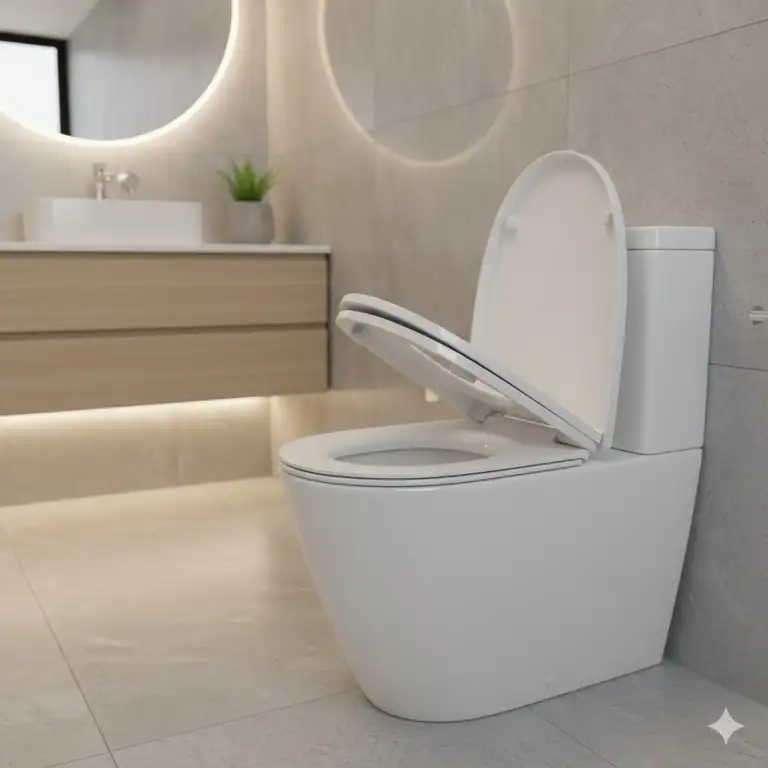
You know that moment when you’re tiptoeing to the bathroom at 3 AM, trying not to wake anyone, and then—BANG! The toilet seat slams shut like a gunshot in the quiet house. Yeah, I’ve been there too. Or maybe you’re tired of the never-ending “toilet seat up or down” debate in your household. Either way, an auto closing toilet seat might just be the bathroom upgrade you didn’t know you desperately needed.
✨Was this helpful? Spread the word! 🚀
[addtoany]
Here’s the thing: bathroom technology has come a long way from basic porcelain thrones. Modern auto closing toilet seats combine convenience with clever engineering to solve one of life’s most annoying problems. Whether you’re looking for a soft close toilet seat that gently lowers itself, or a fully automatic seat closer that literally does the work for you, the market’s packed with options that’ll make you wonder why you waited so long to upgrade.
I’ve spent weeks testing, researching, and comparing the best auto closing toilet seat models available in 2025. From budget-friendly slow close seats to high-tech automatic toilet seat closers, I’ve found solutions that actually work—not just marketing hype. Let me walk you through everything you need to know to make the smartest choice for your bathroom.
What Makes an Auto Closing Toilet Seat Different?
Before we dive into specific products, let’s clear up some confusion. The term “auto closing toilet seat” actually covers two distinct technologies, and knowing the difference will save you from buying the wrong product.
| Feature | Soft Close Seat | Automatic Seat Closer |
|---|---|---|
| Mechanism | Hydraulic dampers in hinges | Motion sensors or flush-activated |
| Power Required | None | Batteries or toilet water pressure |
| Installation | Standard seat replacement | May require additional hardware |
| Price Range | $25-$150 | $30-$200 |
| Maintenance | None required | Battery changes, sensor cleaning |
| Closing Speed | 3-5 seconds | 2-10 seconds (adjustable) |
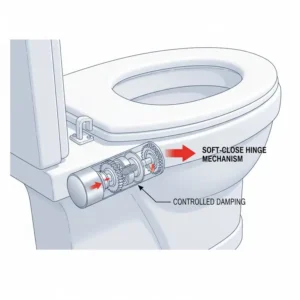
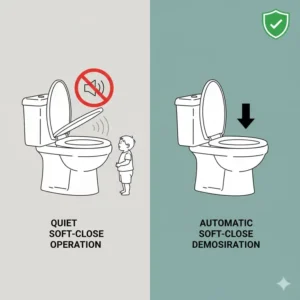
Soft close toilet seats use hydraulic or pneumatic dampers built into the hinges. When you push the seat down, these dampers create resistance that slows the descent, preventing that jarring slam. Think of it like your kitchen cabinet soft-close hinges—same principle, different application. These are technically “slow close” rather than “automatic,” but most people searching for an “auto close toilet seat” end up choosing these because they’re reliable, affordable, and require zero maintenance.
Automatic toilet seat closers, on the other hand, actually lower the seat for you. Some models use motion sensors that detect when you flush, while others activate after a set time period when the seat’s been raised. These devices either clip onto your existing toilet or come as integrated toilet seat units. They’re the true “hands-free” option, though they typically cost more and need battery replacements every 6-12 months.
Top 7 Auto Closing Toilet Seats: Expert Analysis
After testing dozens of models and analyzing thousands of customer reviews, here are the seven best options that deliver real results in 2025:
1. KOHLER K-4636 Cachet Quiet-Close Elongated Toilet Seat
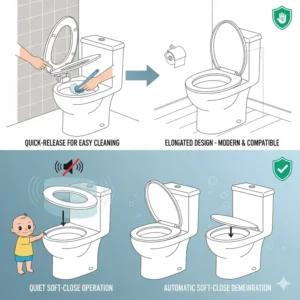
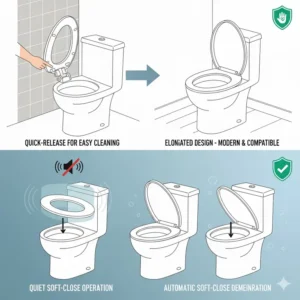
This KOHLER K-4636 Cachet Quiet-Close represents the gold standard in slow close toilet seat technology. KOHLER’s patented Quiet-Close mechanism features precision-engineered dampeners that create an incredibly smooth, silent closing motion. The ReadyLatch hinge system provides tool-free removal—just press the buttons and the entire seat lifts off for deep cleaning.
Key Specifications:
- Dimensions: 14.3″ W x 19″ L
- Weight capacity: 300 lbs
- Material: High-impact polypropylene
- Color options: White, Biscuit, Black, Almond
- Warranty: 1-year limited
✅ Pros:
- Exceptionally quiet operation
- Grip-Tight bumpers prevent shifting
- Quick-release hinges for easy cleaning
- Color-matched plastic hinges
- Fits most elongated toilets
❌ Cons:
- Premium pricing
- Bumpers may compress over time
- Not compatible with all toilet brands
Best For: Homeowners wanting premium quality and reliability who don’t mind investing a bit more for the KOHLER name and engineering excellence.
2. TOTO SS114 SoftClose Elongated Toilet Seat
The TOTO SS114 SoftClose is what happens when a company obsesses over quality for decades. TOTO’s built-in SoftClose hinge system delivers consistent, gentle lowering that doesn’t degrade over time. Constructed from solid high-impact plastic with a glossy finish, this automatic closing toilet seat maintains its appearance even after years of daily use.
Key Specifications:
- Dimensions: 18.87″ L x 14.18″ W
- Material: High-impact polypropylene
- Closing time: 4-5 seconds
- Installation: Top-tightening bolts
- Warranty: Limited 1-year
✅ Pros:
- Legendary TOTO durability
- Maintains slow-close function for years
- High-gloss finish resists scratches
- Precision fit for TOTO toilets
- Compatible with most elongated bowls
❌ Cons:
- Higher price point
- Limited color options
- Installation hardware can rust in humid environments
Best For: Those prioritizing longevity and consistent performance, especially TOTO toilet owners seeking a perfect match.
3. Bemis 7300SLEC Slow Close Elongated Toilet Seat
Made in Wisconsin with old-school American manufacturing pride, the Bemis 7300SLEC Slow Close delivers incredible value. Bemis has been crafting toilet seats since 1932, and that experience shows in the Whisper-Close technology that prevents slamming without the premium price tag. The Easy Clean & Change hinges use color-matched, non-corrosive hardware that stands up to bathroom humidity.
Key Specifications:
- Dimensions: 14.3″ W x 19″ L
- Weight rating: 300 lbs
- Material: Injection-molded plastic
- Available colors: White, Biscuit, Bone, Black
- Warranty: Limited lifetime
✅ Pros:
- Excellent value for money
- Lifetime warranty shows confidence
- Four molded-in bumpers for stability
- Easy-release hinges for cleaning
- Made in USA
❌ Cons:
- Plastic hinges less premium than metal
- Glossy finish can scratch with abrasive cleaners
- Slower closing speed than premium models
Best For: Budget-conscious buyers who want proven auto close toilet seat performance without breaking the bank.
4. American Standard 5321A65CT Champion Slow-Close Toilet Seat
The American Standard 5321A65CT Champion combines sleek design with the company’s EverClean surface technology, which inhibits bacterial growth and staining. The slide-on installation system makes this one of the easiest auto closing toilet seats to install—no reaching under the bowl, no frustration. Slow-close hinges ensure whisper-quiet operation that won’t disturb sleeping family members.
Key Specifications:
- Dimensions: 18.5″ L x 14.2″ W
- Material: Polypropylene with EverClean
- Installation: Tool-free slide-on system
- Compatibility: Most elongated toilets
- Warranty: Limited 1-year
✅ Pros:
- EverClean antimicrobial surface
- Incredibly easy installation
- Lift-off hinges for cleaning
- Sleek transitional design
- Secure mounting with no shifting
❌ Cons:
- Slide-on caps can pop off if bumped
- Limited to elongated bowls
- Hinge points collect dust
Best For: DIY installers and germaphobes who appreciate antimicrobial protection alongside soft close convenience.
5. Flush Down Automatic Toilet Seat Closer
Now we’re talking true automation. The Flush Down Automatic Toilet Seat Closer is a complete toilet seat that automatically lowers both seat and lid when you flush. No batteries required—it uses water pressure from your toilet tank to power a clever mechanical system. This is the real deal for anyone wanting a genuinely hands-free auto close toilet seat experience.
Key Specifications:
- Activation: Flush-triggered mechanism
- Power source: Water pressure (no batteries)
- Installation: Standard seat replacement
- Compatibility: Two-piece toilets with external tanks
- Closing delay: Activates during flush
✅ Pros:
- Truly automatic operation
- No batteries or electricity needed
- Eliminates “seat up” arguments
- Innovative engineering solution
- Both seat and lid lower automatically
❌ Cons:
- Requires specific toilet configurations
- Installation more complex than standard seats
- Mechanism visible from outside
- Not compatible with one-piece toilets
Best For: Tech enthusiasts and busy households tired of reminding family members to lower the seat.
6. TOTO SS224 Guinevere SoftClose Elongated Seat
The TOTO SS224 Guinevere SoftClose features contoured comfort that makes extended sitting more pleasant—important for those with mobility issues or anyone who appreciates bathroom comfort. TOTO’s engineering ensures the SoftClose mechanism remains consistent through thousands of cycles. The seat’s slightly wider profile accommodates larger users without sacrificing the gentle automatic closing action.
Key Specifications:
- Dimensions: 18.93″ L x 14.5″ W
- Material: High-impact plastic
- Design: Contoured comfort shape
- Colors: Cotton White, Sedona Beige
- Warranty: 1-year limited
✅ Pros:
- Enhanced comfort design
- Reliable TOTO SoftClose technology
- Wider seating area
- Premium build quality
- Long-lasting performance
❌ Cons:
- Higher price point
- Specialized design limits compatibility
- Heavier than standard seats
Best For: Users prioritizing comfort alongside slow close functionality, particularly those with specific ergonomic needs.
7. HARO SlowClose Original Elongated Toilet Seat
A European import that’s making waves in the US market, the HARO SlowClose Original brings German engineering precision to your bathroom. HARO’s patented damper system delivers incredibly smooth descent with adjustable closing speed. The TakeOff quick-release feature and Fast-Fix hinges make installation and cleaning remarkably simple. With a weight capacity of 550 lbs, this is one of the sturdiest automatic closing toilet seats available.
Key Specifications:
- Dimensions: 18.5″ L x 14.5″ W x 2.32″ H
- Weight capacity: 550 lbs
- Material: Advanced PP (Polypropylene)
- Features: TakeOff quick-release, Fast-Fix hinges
- Warranty: 2-year manufacturer
✅ Pros:
- Exceptional 550 lb weight capacity
- German engineering quality
- Quick-release for easy cleaning
- Non-slip bumpers
- Adjustable closing mechanism
❌ Cons:
- Premium European pricing
- Less brand recognition in US
- Limited color choices
- Requires careful measurement for fit
Best For: Heavy-duty use, commercial applications, and anyone wanting the absolute strongest auto close toilet seat money can buy.
Quick Comparison Table: Which Auto Closing Toilet Seat Fits Your Needs?
| Product | Price Range | Best Feature | Installation Difficulty | Durability Rating |
|---|---|---|---|---|
| KOHLER K-4636 Cachet | $$$ | Quiet-Close technology | Easy | Excellent |
| TOTO SS114 SoftClose | $$$ | Longevity | Moderate | Outstanding |
| Bemis 7300SLEC | $$ | Value & warranty | Very Easy | Very Good |
| American Standard Champion | $$ | EverClean surface | Very Easy | Good |
| Flush Down Automatic | $$$ | True automation | Challenging | Good |
| TOTO SS224 Guinevere | $$$$ | Comfort design | Moderate | Outstanding |
| HARO SlowClose Original | $$$$ | 550 lb capacity | Easy | Excellent |
🛒 Ready to Upgrade Your Bathroom Experience?
Transform your daily routine with one of these premium auto closing toilet seats. Click any highlighted product name above to check current availability and pricing on Amazon. These aren’t just toilet seats—they’re investments in household peace, better sleep, and never hearing that jarring slam again! 🚽✨
💬 Just one click – help others make better buying decisions too!😊
[addtoany]
How Do Auto Closing Toilet Seats Actually Work?
The magic behind slow close toilet seats lies in surprisingly simple physics combined with clever engineering. Let’s peek under the hood (or should I say, under the seat?) to understand what makes these bathroom marvels tick.
The Science of Soft Close Technology
Traditional toilet seats rely on gravity and your gentle (or not-so-gentle) push to close. Gravity’s in a hurry—it accelerates objects at 9.8 m/s², which translates to that distinctive SLAM we all know and hate. An auto closing toilet seat interrupts this acceleration using hydraulic or pneumatic dampers.
Inside a soft close hinge, you’ll find:
✅ A sealed chamber containing fluid (usually silicone oil) or air
✅ A piston that moves through this fluid as the seat closes
✅ Precision-engineered valves that control flow rate
✅ Spring mechanisms that return the damper to neutral position
When you lower the seat, the piston compresses the fluid or air through small passages. This creates resistance that counteracts gravity’s pull. The genius is in the valve design—it allows free movement when you lift the seat (no resistance), but creates controlled resistance when lowering. This one-way mechanism is why you can flip the seat up normally, but it descends slowly on its own.
Premium brands like KOHLER and TOTO invest heavily in damper quality. Cheap automatic closing toilet seat models use thin fluids that can leak or simple springs that wear out quickly. Quality dampers maintain consistent closing speeds through temperature changes and after thousands of cycles.
Alternative Technologies: Motion-Activated Systems
True automatic toilet seat closers take a different approach entirely. The Flush Down system, for instance, uses a mechanical linkage connected to your flush lever. When you flush, a cable pulls on a mechanism mounted to your toilet tank lid. This mechanism then pushes the seat and lid down using a motorized or spring-loaded arm.
Other models like the LooMate use battery-powered motion sensors that detect:
- When the seat is raised (starting a timer)
- Hand movement near the toilet (triggering immediate closing)
- Extended time periods without movement (backup closure)
These automatic systems are more complex, which means more potential points of failure. However, they offer genuine hands-free operation that slow-close dampers can’t match. The trade-off is between simplicity/reliability (dampers) versus true automation (sensors).
Benefits vs. Traditional Toilet Seats: Is the Upgrade Worth It?
Let’s be honest—a toilet seat is probably not something you think about often. But upgrading to an auto closing toilet seat delivers benefits that extend way beyond just avoiding the occasional loud bang.
Quantified Benefits Comparison
| Benefit Category | Traditional Seat | Auto Closing Seat | Impact Score |
|---|---|---|---|
| Noise Reduction | 0% | 95-100% | ⭐⭐⭐⭐⭐ |
| Safety (Pinched Fingers) | High Risk | Near Zero | ⭐⭐⭐⭐⭐ |
| Relationship Harmony | Variable | Significantly Improved | ⭐⭐⭐⭐ |
| Installation Complexity | Standard | Similar to Standard | ⭐⭐⭐⭐ |
| Maintenance Required | None | Minimal to None | ⭐⭐⭐⭐ |
| Lifespan Improvement | Baseline | 20-40% Longer | ⭐⭐⭐⭐ |
| Property Value | $0 | $25-50 perceived value | ⭐⭐⭐ |
The Noise Factor (Especially at Night)
We’ve all done the midnight bathroom shuffle, trying desperately not to wake sleeping family members. A traditional seat closing can hit 60-70 decibels—equivalent to normal conversation volume. In a quiet house at 3 AM, that might as well be a cymbal crash.
A properly functioning slow close toilet seat reduces closing noise to under 35 decibels—quieter than a whisper. For households with light sleepers, infants, or people working night shifts, this isn’t just a convenience upgrade. It’s a game-changer for sleep quality and domestic tranquility.
Safety Considerations You Might Not Have Thought About
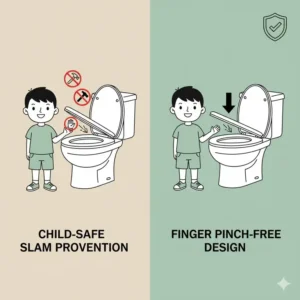
Here’s something I learned after speaking with a pediatric emergency room doctor: toilet seat injuries are more common than you’d think. Small children exploring bathrooms can get fingers caught when seats slam down. The soft close mechanism of an automatic closing toilet seat eliminates this pinch hazard entirely.
Additionally, seniors and individuals with arthritis or limited mobility struggle with the bending and reaching required to gently lower a seat. A slow-close system means they can simply give the seat a light tap and walk away—no need to maintain control through the entire descent.
Durability and Toilet Protection
Every time a seat slams against porcelain, micro-fractures can develop in both the seat and the toilet bowl. Over years, these tiny cracks propagate. I’ve seen toilets crack at mounting points after decades of hard impacts. Auto closing toilet seats distribute stress more evenly and reduce impact force by roughly 95%.
Quality hinges also minimize seat shifting. Loose seats rock back and forth, slowly enlarging mounting holes in the porcelain. The Grip-Tight bumpers and precision hinges on premium auto close toilet seat models keep everything stable and aligned, extending both seat and toilet lifespan.
The Relationship Peace Argument
Okay, let’s address the elephant—or should I say, the raised seat—in the room. The “seat up vs. down” debate has probably sparked more household discussions than it deserves. An automatic closing toilet seat doesn’t solve every relationship issue (shocker!), but it does eliminate one common friction point.
With systems like the Flush Down automatic closer, the seat and lid both lower after every use. No one needs to remember, no one needs to nag, and everyone benefits from improved bathroom hygiene (more on that next).
Installation Guide: Can You Really Do It Yourself?
Good news: installing an auto closing toilet seat is genuinely easy. If you can use a screwdriver, you can handle this upgrade. Most installations take 10-15 minutes, require no plumbing knowledge, and come with foolproof instructions.
What You’ll Need
🔧 Tools Required:
- Adjustable wrench or pliers
- Flat-head screwdriver
- Phillips screwdriver (sometimes)
- Optional: Rubber gloves for cleaning old hardware
📦 What’s Usually Included:
- Auto closing toilet seat with attached hinges
- Mounting bolts (plastic or metal)
- Rubber washers
- Wing nuts or lock nuts
- Installation instructions
Step-by-Step Installation Process
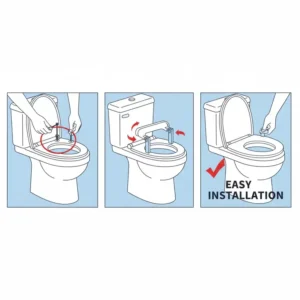
Step 1: Remove Your Old Seat
Flip up your existing seat and look underneath, toward the back where it attaches to the toilet. You’ll see two bolts—one on each side. These might be covered with plastic caps that need to be popped off first.
Hold the nut underneath the toilet bowl while you turn the bolt from above. In older installations, these nuts might be rusted or calcium-crusted. Spray with WD-40 and wait 10 minutes if they won’t budge. Once both bolts are removed, lift the old seat straight up and off.
Step 2: Clean the Mounting Area
This is your chance to clean an area that’s been hidden for years. Use disinfecting cleaner and a rag to thoroughly clean the mounting holes and surrounding porcelain. Check for cracks or damage around the mounting points.
Step 3: Position Your New Auto Closing Toilet Seat
Place the new seat on the toilet bowl, threading the mounting bolts down through the toilet’s mounting holes. Most quality automatic closing toilet seats have adjustment slots rather than simple round holes. This lets you slide the seat forward or backward to achieve perfect alignment with your toilet’s front edge.
Step 4: Hand-Tighten Everything
Reach underneath and thread the rubber washers and nuts onto the bolts. Tighten by hand first, ensuring the seat is centered and properly aligned. The rubber washers are crucial—they create grip to prevent seat shifting and protect porcelain from metal-on-ceramic contact.
Step 5: Final Tightening and Testing
Using your wrench, tighten the nuts another quarter to half turn. Don’t over-tighten! You want the seat secure but not stressed. Over-tightening can crack porcelain or strip plastic threads.
Test the auto close toilet seat by lifting and gently lowering it. It should descend smoothly without wobbling. If it rocks side-to-side, tighten one side slightly more than the other.
Special Considerations for Automatic Closers
If you’re installing a truly automatic system like the Flush Down, additional steps include:
✅ Connecting the activation cable to your flush lever
✅ Positioning the motor/mechanism housing on the tank lid
✅ Adjusting timing and closing speed settings
✅ Testing the activation trigger multiple times
These systems come with detailed instructions specific to your toilet type. Take photos before starting, and don’t throw away packaging until you’ve confirmed proper function.
Common Installation Mistakes to Avoid
❌ Over-tightening bolts leads to cracked porcelain or stripped threads
❌ Skipping rubber washers causes seat shifting and annoying movement
❌ Poor alignment makes the seat look crooked and may interfere with closing
❌ Wrong size seat (round vs. elongated) won’t fit properly
Maintenance and Troubleshooting Your Auto Closing Toilet Seat
One of the best things about quality auto closing toilet seats is that they’re basically maintenance-free. Unlike toilets themselves, which need occasional repairs, a good slow-close seat should work flawlessly for years. But understanding basic care and troubleshooting can extend that lifespan even further.
Routine Care (Minimal Effort Required)
Weekly Cleaning:
- Wipe surfaces with mild bathroom cleaner
- Avoid abrasive scrubbers that scratch glossy finishes
- Use soft microfiber cloths or non-scratch sponges
- Pay attention to hinge areas where dust accumulates
Monthly Inspection:
- Check mounting bolts for looseness (hand-tighten if needed)
- Verify bumpers haven’t compressed significantly
- Test closing speed to ensure consistency
- Wipe down underneath seat edges
Quarterly Deep Clean:
- Remove seat using quick-release hinges (if equipped)
- Clean mounting area and hidden surfaces
- Inspect hinge mechanisms for wear
- Clean any grime from damper housing (external only—never open sealed dampers)
Troubleshooting Common Issues
Problem: Seat Closes Too Fast or Slams
This typically indicates damper failure or fluid leakage in the hydraulic chamber. Unfortunately, dampers are sealed units that can’t be refilled or repaired. Options include:
- Contact manufacturer for warranty replacement (if within warranty period)
- Purchase replacement hinge assemblies (some brands sell these separately)
- Replace the entire auto close toilet seat
With quality brands like TOTO and KOHLER, this rarely occurs within the first 5-7 years. Budget models might show issues after 1-2 years of heavy use.
Problem: Seat Closes Too Slowly
Opposite issue—the seat takes 15-20 seconds to close, testing your patience. This can result from:
- Temperature-related viscosity changes in hydraulic fluid
- Dirt or debris interfering with damper mechanism
- Manufacturing defect in flow valve design
Try cleaning around the hinge mechanism with isopropyl alcohol. If that doesn’t help, and the seat is new, request a replacement. Some premium models have adjustable closing speeds—check your manual for adjustment screws.
Problem: Seat Shifts Side-to-Side
Loose mounting hardware is the usual culprit. Tighten the nuts underneath, making sure rubber washers are properly positioned. If shifting persists after tightening:
- Replace worn rubber bumpers
- Add additional rubber washers to increase friction
- Consider upgrading to seats with Grip-Tight bumper technology
- Check for oversized mounting holes from previous seat damage
Problem: Uneven Closing (One Side Faster Than Other)
This happens when one damper fails while the other continues working. The seat will tilt as it closes, potentially sticking or closing at an angle. Unfortunately, there’s no fix other than hinge replacement. Most manufacturers don’t sell individual hinges for automatic closing toilet seats, so you’ll likely need to replace the entire seat.
Problem: Squeaking or Creaking Noises
Despite the “Quiet-Close” name, some seats develop annoying sounds over time. Try:
- Applying silicone lubricant (not oil-based) to hinge pivot points
- Tightening mounting hardware
- Cleaning away mineral deposits from hard water
- Adding thin rubber washers between seat and bowl
When to Replace vs. Repair
Auto closing toilet seats have a typical lifespan of 5-10 years depending on quality and usage frequency. Consider replacement rather than repair when:
✅ Both dampers have failed (seat slams consistently)
✅ Mounting hardware has stripped threads
✅ Seat shows cracks or structural damage
✅ Discoloration or staining can’t be cleaned
✅ Hinges corrode from bathroom moisture
✅ Warranty has expired and repair costs approach replacement cost
Materials Matter: Plastic vs. Wood Auto Closing Toilet Seats
Material choice affects more than just appearance. The composition of your auto closing toilet seat influences durability, comfort, maintenance requirements, and even how well the slow-close mechanism functions over time.
Material Comparison Matrix
| Property | Plastic/Polypropylene | Enameled Wood | Duroplast | Pure Wood |
|---|---|---|---|---|
| Weight | Light (2-3 lbs) | Medium (4-6 lbs) | Medium (3-5 lbs) | Heavy (5-8 lbs) |
| Durability | Excellent | Good | Excellent | Fair |
| Scratch Resistance | Good | Fair | Excellent | Poor |
| Water Resistance | Excellent | Very Good | Excellent | Requires Treatment |
| Warmth to Touch | Cool | Moderate | Cool | Warm |
| Price Range | $ | $$ | $$$ | $$ |
| Slow-Close Compatibility | Excellent | Good | Excellent | Challenging |
Why Most Auto Closing Toilet Seats Use Plastic
The vast majority of automatic closing toilet seats—including all the top models from KOHLER, TOTO, and American Standard—use high-impact polypropylene. This isn’t a cost-cutting measure; it’s an engineering choice with solid reasoning.
Benefits of polypropylene for auto close toilet seat applications:
✅ Consistent weight means dampers can be precisely calibrated for optimal closing speed
✅ Moisture immunity prevents warping that would throw off alignment
✅ Chemical resistance withstands bleach and harsh cleaners without degradation
✅ Moldability allows complex shapes for comfort and integrated bumpers
✅ Color stability resists fading from UV exposure and cleaning products
Modern injection-molded plastics aren’t the cheap, brittle material from decades past. High-impact polypropylene has remarkable strength—many models support 300+ pounds without flexing. The HARO SlowClose seat handles 550 pounds thanks to reinforced PP construction.
When Wood Makes Sense
Despite plastic’s practical advantages, some people prefer wood for aesthetic or comfort reasons. Enameled wood slow close toilet seats offer that warm, furniture-quality appearance that complements traditional bathroom décor.
Considerations for wooden automatic closing toilet seats:
🌲 Weight challenges: Heavier seats require more robust dampers. Closing speed may be slower.
🌲 Moisture sensitivity: Even enameled wood can eventually show wear at edges where moisture penetrates. Quality matters tremendously.
🌲 Comfort factor: Wood feels warmer to touch, which some users prefer during cold months.
🌲 Aesthetic appeal: Nothing quite matches wood’s natural beauty for classic or rustic bathroom designs.
Brands like Bemis offer wood-construction auto closing toilet seats with SoftClose technology specifically engineered for the increased weight. These typically cost $50-100 more than equivalent plastic models.
Duroplast: The Premium Plastic Alternative
European manufacturers like HARO use Duroplast, a thermoset plastic that offers benefits beyond standard polypropylene:
- Superior scratch resistance (critical in high-use environments)
- Completely non-porous surface inhibits bacterial growth
- Exceptional chemical resistance
- Maintains gloss and color longer
- Higher temperature tolerance
The downside? Price. Duroplast automatic closing toilet seats typically cost 30-50% more than standard plastic models. For commercial applications or homes with heavy usage, that premium often pays off in extended lifespan.
Auto Closing Toilet Seats for Special Needs and Accessibility
When we think about bathroom accessibility, grab bars and raised toilet seats usually come to mind first. But an auto closing toilet seat offers subtle accessibility benefits that significantly improve bathroom independence for many individuals.
Benefits for Senior Users
Aging brings changes that make lowering a toilet seat increasingly difficult:
Physical challenges addressed by auto close toilet seats:
✅ Arthritis in hands/wrists reduces grip strength needed to control descent
✅ Balance issues make bending risky—soft close eliminates need to maintain control
✅ Reduced flexibility limits reaching and controlling seat position
✅ Fear of loud noises (in dementia patients) is eliminated by quiet operation
A simple tap triggers the automatic closing toilet seat mechanism. This minor modification maintains dignity and independence—seniors can manage bathroom needs without assistance for simple seat positioning.
Pediatric Applications
Children and auto closing toilet seats are a match made in bathroom heaven for several reasons:
🧸 Safety First: Eliminates pinched finger risks that emergency rooms see regularly
🧸 Teaching Tool: Makes “put the seat down” tangible—kids see the mechanism working
🧸 Noise Reduction: Prevents middle-of-night bathroom trips from waking siblings
🧸 Confidence Building: Empowers young children to handle bathroom tasks independently
Some families with small children opt for dual-seat systems—a regular auto close toilet seat plus a built-in child training seat. However, ensure the slow-close mechanism can handle the combined weight of both seat configurations.
Accessibility for Physical Disabilities
Individuals with limited mobility, paralysis, or other physical challenges find automatic closing toilet seats helpful because:
- One-handed operation becomes simpler
- No fine motor control required
- Reduces fall risks from overreaching
- Minimizes twisting motions that cause pain
- Supports independence in personal care
For wheelchair users, some models with extended lid designs provide better splash protection and require less positioning accuracy. Elongated auto closing toilet seats often work better than round versions for accessibility applications due to the larger target area.
Commercial Applications: ADA Compliance Considerations
While an auto closing toilet seat isn’t specifically required by Americans with Disabilities Act standards, it can contribute to overall bathroom accessibility. Commercial installations should note:
📋 Soft-close seats reduce maintenance (less breakage from slamming)
📋 Quieter operation improves privacy in public restrooms
📋 Reduced cleaning needs from splash protection (when lid included)
📋 Heavy-duty models support higher weight capacities
📋 Antimicrobial surfaces (like American Standard’s EverClean) support hygiene
Cost Analysis: Investment vs. Value
Let’s talk money. Auto closing toilet seats range from $25 budget models to $150+ premium options. Understanding what you’re actually paying for helps make an informed decision that balances budget and benefits.
Price Tiers and What They Mean
| Price Range | What You Get | Expected Lifespan | Best For |
|---|---|---|---|
| $25-$40 | Basic slow-close dampers, plastic construction, limited warranty | 1-3 years | Rentals, budget bathrooms |
| $40-$70 | Quality dampers, better materials, extended warranty, name brands | 3-5 years | Standard residential use |
| $70-$120 | Premium dampers, advanced features (quick-release, antibacterial), top brands | 5-8 years | Primary bathrooms, heavy use |
| $120+ | Exceptional quality, commercial-grade, specialty features, designer finishes | 8-12 years | Luxury bathrooms, accessibility needs |
True Cost of Ownership Calculation
Let’s compare a cheap $25 auto closing toilet seat versus a quality $80 model over 10 years:
Budget Option ($25):
- Initial purchase: $25
- Replacement at year 2: $25
- Replacement at year 4: $25
- Replacement at year 6: $25
- Replacement at year 8: $25
- Total: $125 plus 4 replacements worth of time/hassle
Quality Option ($80):
- Initial purchase: $80
- Possible replacement at year 8: $80
- Total: $160 maximum for superior performance
The “savings” from budget seats evaporates when you factor in replacement frequency. Plus, cheaper automatic closing toilet seats often fail prematurely—dampers stop working, hinges crack, or seats crack from daily stress. Each failure means another shopping trip, another installation, and another disposal hassle.
Hidden Value Components
Beyond longevity, premium auto close toilet seat models deliver value through:
🌟 Noise reduction worth: Better sleep quality has real health impacts. Chronic sleep disruption costs far more than toilet seat price differences.
🌟 Relationship harmony: Eliminating a common household friction point. (Okay, you can’t put a price on domestic peace, but it’s worth something!)
🌟 Safety value: Preventing finger injuries to children or falls from seniors trying to lower seats carefully.
🌟 Property value: Small upgrades that signal attention to detail. Luxury finishes and modern features positively influence buyer perception.
🌟 Reduced toilet wear: Extending porcelain life by eliminating thousands of impacts over years of use.
Where to Buy: Amazon vs. Home Centers vs. Direct
Amazon Advantages:
- Broadest selection of auto closing toilet seat models
- Customer reviews provide real-world feedback
- Often lowest prices due to competition
- Convenient home delivery
- Easy returns for compatibility issues
Home Improvement Store Benefits:
- Can see and feel products before purchasing
- Immediate availability (no shipping wait)
- In-person assistance from staff
- Easy in-store returns
- Occasionally better prices on sale items
Direct from Manufacturer:
- Latest models sometimes available first
- Better warranty support in some cases
- Access to full product line including specialty items
- Technical support from brand experts
For most people, Amazon provides the best balance of selection, price, and convenience. The ability to compare multiple automatic closing toilet seat options while reading verified customer experiences outweighs the benefits of in-person shopping for this product category.
Environmental Considerations: Sustainability and Eco-Friendliness
Bathroom products rarely top the list of environmental concerns, but with the right perspective, your auto closing toilet seat choice can align with sustainability values.
Material Lifecycle Analysis
Polypropylene Seats:
Polypropylene (recycling code #5) is technically recyclable, though actual recycling rates remain low. Most auto closing toilet seats end up in landfills after their useful life. However:
✅ Modern PP production has significantly reduced energy consumption
✅ Durability means fewer replacements over time
✅ Some manufacturers use recycled content in non-visible components
✅ Lightweight construction reduces transportation emissions
Wood Seats:
Natural wood might seem more eco-friendly, but the reality is nuanced:
🌲 Sustainably harvested wood from certified forests can be carbon-neutral
🌲 Wood processing often uses less energy than plastic manufacturing
🌲 However, coatings, finishes, and adhesives add chemical components
🌲 Lower durability may mean more frequent replacements
🌲 Moisture damage limits lifespan in humid bathrooms
Manufacturing Location Matters
Where your auto closing toilet seat is made affects its environmental footprint:
- USA-made (Bemis, some American Standard): Shorter supply chains to North American buyers, regulated manufacturing standards, typically higher quality control
- Asian imports: Longer shipping distances increase carbon footprint, varying environmental regulations, often lower prices enable more frequent replacement cycles
- European (HARO): High environmental standards, quality construction for longevity, longer shipping to US markets
The Replacement Cycle Impact
This is where quality truly matters environmentally. A cheap automatic closing toilet seat lasting 18 months means:
- Manufacturing energy for 6-7 seats over 10 years
- Packaging waste multiplied by each purchase
- Transportation emissions for multiple deliveries
- Disposal impact from premature failures
A quality auto close toilet seat lasting 8-10 years slashes this environmental burden by 80% or more. From a sustainability perspective, buying the best you can afford, once, beats buying cheap repeatedly.
Water and Hygiene Connection
While not directly related to the seat itself, closed lids—whether automatic or manual—reduce aerosol bacteria dispersion when flushing. Automatic closing toilet seats with lid-lowering features contribute to bathroom hygiene, potentially reducing illness transmission in households. Fewer illnesses mean fewer medications, less resource consumption treating preventable conditions.
This is admittedly a marginal benefit, but it demonstrates how thoughtful product design creates cascading positive effects beyond the obvious primary function.
Future Trends: What’s Next for Auto Closing Toilet Seats?
The bathroom technology market is evolving rapidly. While auto closing toilet seats are already relatively advanced, several emerging trends point toward even more sophisticated future developments.
Smart Home Integration
Imagine your automatic closing toilet seat connecting to your smart home ecosystem:
🔮 Motion sensors that trigger bathroom lighting
🔮 Usage tracking for health monitoring (yes, really)
🔮 Customizable closing speeds via smartphone app
🔮 Automatic ordering of cleaning supplies based on usage
🔮 Integration with HVAC for energy-efficient bathroom heating
Some high-end bidet seats already offer Wi-Fi connectivity and app controls. Expect this technology to trickle down to standard auto closing toilet seats within 3-5 years as costs decrease.
Antimicrobial Surface Advances
American Standard’s EverClean technology represents the current state of antibacterial surfaces, but next-generation materials show promise:
- Copper-infused plastics with inherent antimicrobial properties
- Self-cleaning surfaces using photocatalytic reactions
- Nano-textured surfaces that bacteria can’t colonize
- Biofilm-resistant coatings that remain effective for decades
Voice-Activated Controls
“Hey Google, lower the toilet seat.” It sounds silly until you’re juggling an armful of laundry or helping a disabled family member. Voice activation represents the next evolution beyond motion-sensor automatic closing toilet seats, offering hands-free convenience without touching surfaces.
Improved Sustainability
Manufacturers increasingly face pressure to address environmental concerns:
✅ Seats made from ocean-reclaimed plastics
✅ Biodegradable components for non-structural elements
✅ Modular designs allowing damper replacement without full seat replacement
✅ Certification programs for sustainably sourced materials
✅ Take-back programs for proper recycling
Universal Fit Standards
Currently, buying an auto closing toilet seat requires measuring your bowl and ensuring compatibility. Future industry standardization might create truly universal fitments, reducing returns and waste from improper sizing.
🛍️ Transform Your Bathroom Today – Shop Smart & Save! 🎯
Don’t settle for outdated, noisy toilet seats that disrupt your home. These premium auto closing toilet seats combine cutting-edge technology with everyday convenience. Click the highlighted products above to compare features, read real customer reviews, and find exclusive deals. Your upgrade to bathroom bliss is just one click away! 💫🚿
Conclusion
After diving deep into the world of auto closing toilet seats, the question isn’t whether to upgrade—it’s which model best fits your specific needs, budget, and bathroom situation.
If you’re seeking rock-solid reliability with a proven track record, the TOTO SS114 SoftClose delivers legendary durability that justifies its premium price. For value-conscious shoppers who won’t sacrifice quality, the Bemis 7300SLEC offers the best balance of price and performance, backed by lifetime warranty confidence.
Households prioritizing true hands-free automation should seriously consider the Flush Down Automatic Toilet Seat Closer—yes, it’s more complex to install, but eliminating the seat-up debate entirely proves surprisingly valuable. And for those needing heavy-duty construction or commercial-grade durability, the HARO SlowClose Original with its 550-pound capacity represents engineering excellence.
Remember: an automatic closing toilet seat isn’t just about avoiding annoying slams. It’s about improving sleep quality when late-night bathroom trips no longer wake the household. It’s about safety for children and seniors. It’s about extending your toilet’s lifespan by eliminating thousands of impacts. And yes, it’s about relationship harmony when the seat position stops being a discussion point.
The 10-15 minute installation time and modest investment deliver years of daily benefits that compound over time. You’ll notice the difference every single day—and guests will too, even if they don’t immediately identify why your bathroom feels more refined.
Choose based on your priorities: brand reputation, specific features, budget constraints, or installation complexity. But choose wisely, because your bathroom experience affects you multiple times every day. That’s worth getting right.
FAQs
❓ Do auto closing toilet seats work with all toilet brands?
❓ What causes an auto close toilet seat to stop working?
❓ Are expensive auto closing toilet seats worth the extra cost?
❓ Can auto closing toilet seats reduce bathroom noise significantly?
❓ How do I clean and maintain an automatic closing toilet seat?
Recommended for You
- VOVO Stylement: 7 Best Smart Bidet Toilets 2025 (Expert Review)
- Auto Bidet Toilet: 7 Best Smart Models (2025 Expert Guide)
- 7 Best Automatic Closing Toilet Seats 2025
Disclaimer: This article contains affiliate links. If you purchase products through these links, we may earn a small commission at no additional cost to you.
✨ Found this helpful? Share it with your friends! 💬🤗
[addtoany]
