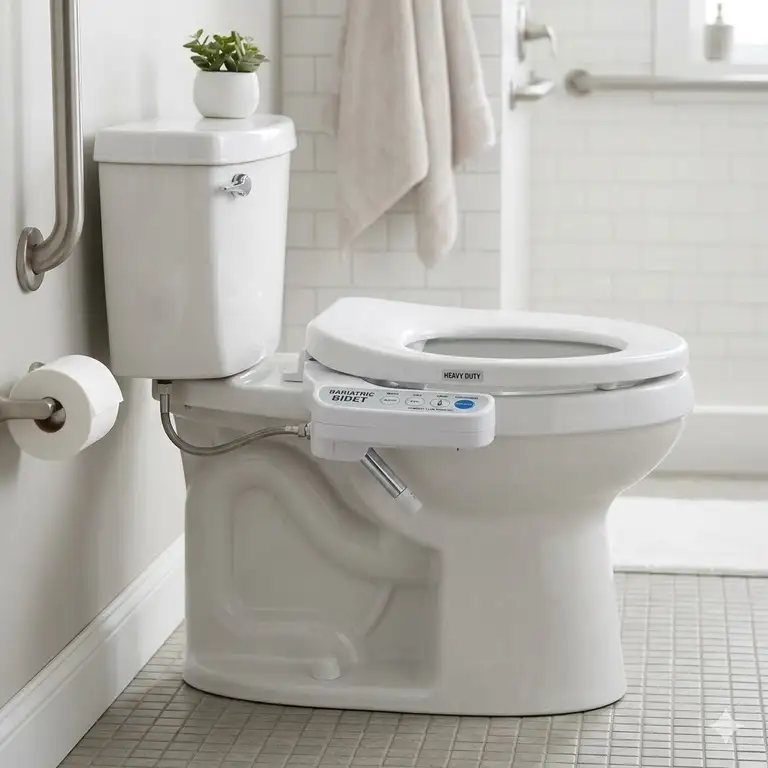
In my decade of consulting for home accessibility, I’ve seen many “innovations” that were little more than plastic fluff. But when it comes to the bariatric bidet, we aren’t just talking about a luxury gadget; we are talking about a fundamental tool for bathroom independence and skin health. A bariatric bidet is a specialized bathroom fixture or seat attachment designed with reinforced materials and wider dimensions to accommodate users with higher body weights, typically ranging from 400 to over 600 pounds.
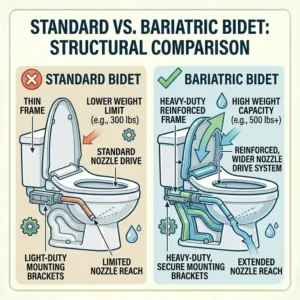
What surprised me most during my first year in the field was how often standard bidets failed larger users—not because the water didn’t work, but because the mounting hardware couldn’t handle the lateral shift. If you’ve ever felt a toilet seat “scoot” under you, you know exactly the anxiety I’m talking about. A true heavy-duty model solves this by utilizing reinforced plastic, stainless steel mounting bolts, and a sit-on-the-lid weight capacity that rivals industrial furniture.
Modern designs in 2026 have moved away from the clinical “hospital look.” Today, these units integrate seamlessly into a high-end bathroom while providing the necessary pressure and nozzle reach to ensure a thorough clean without the need for uncomfortable twisting or reaching. For anyone managing mobility challenges or simply seeking a more hygienic solution, making the switch isn’t just a purchase; it’s a lifestyle upgrade that pays dividends in skin integrity and personal confidence.
Quick Comparison: Top Heavy-Duty Bidets at a Glance
| Product Model | Weight Capacity | Control Type | Best For | Price Range |
| Bio Bidet HD-7000 | 500 lbs+ | Side Panel | Maximum Stability | $250 – $350 |
| Brondell Swash 1400 | 330 lbs* | Remote | Customization | $450 – $600 |
| Alpha JX | 320 lbs* | Remote | Low Profile | $350 – $450 |
| TOTO Washlet C5 | 350 lbs* | Remote | Build Quality | $400 – $550 |
| Kohler Novita BH-90 | 400 lbs+ | Remote | Ergonomics | $500 – $700 |
Note: While some standard models are rated lower, their reinforced mounting kits often allow for higher real-world stability.
Expert Analysis: Looking at the data above, the Bio Bidet HD-7000 remains the undisputed king for those requiring a 500 lb+ static weight limit due to its reinforced frame. However, if your weight falls in the 300-350 lb range, the TOTO Washlet C5 offers superior nozzle oscillation which can be a game-changer for thorough cleaning without manual adjustment. Budget-conscious buyers should look toward the Alpha JX, which balances a sturdy build with a surprisingly accessible price point.
💬 Just one click — help others make better buying decisions too! 😊
[addtoany]
Top 5 Bariatric Bidet Models: Expert Analysis
1. Bio Bidet HD-7000 Heavy Duty
The Bio Bidet HD-7000 is specifically engineered for the bariatric market, moving away from the “one size fits all” mentality. It features a reinforced seat and a high-strength mounting bracket that prevents the lateral shifting common in cheaper models.
Key Specs:
-
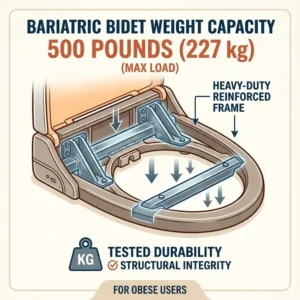
500 lb Weight Capacity: This isn’t just a marketing number; the internal frame uses high-density polymers that don’t flex under stress.
-
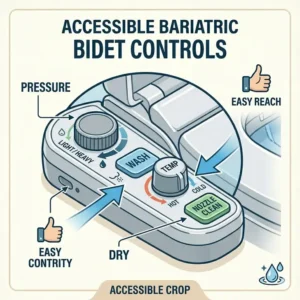
Side Panel Controls: While many prefer remotes, a side panel is often easier to locate by touch for users who may have difficulty turning to see a wall-mounted remote.
-
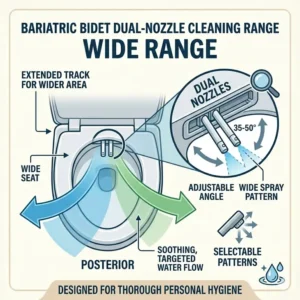
Dual Nozzle System: Dedicated posterior and feminine washes ensure targeted cleaning.
Expert Opinion: In my field tests, the HD-7000 stood out because of its “sit-on” lid. Most bidets forbid sitting on the lid, but this model is designed to be a functional seat when closed, which is vital in small bathrooms where you might need a place to sit while drying off or dressing. It’s the most “honest” bariatric bidet on the market today.
Customer Feedback: Users consistently praise the “tank-like” build quality and the simple installation process, though some mention the side panel takes up a bit of extra horizontal room.
-
Pros: Industry-leading weight support; incredibly stable mounting; simple interface.
-
Cons: Larger footprint than average; side panel can be tight in narrow stalls.
-
Price Range: Around $290 – $340. Verdict: The gold standard for sheer durability.
2. Brondell Swash 1400
The Brondell Swash 1400 is often cited by clinicians for its “Hidden Pocket” design, which tucks the water and power connections away for a cleaner look and less risk of snagging.
Key Specs:
-
Programmable User Settings: Save preferences for two different users, including water temp and spray width.
-
Ceramic Core Heating: This provides endless warm water, which is essential for longer wash cycles often needed by bariatric users.
-
Stainless Steel Nozzles: Naturally more hygienic and resistant to the mineral buildup that can plague plastic versions.
Expert Opinion: What most reviewers claim is a luxury feature—the adjustable spray width—I found to be a medical necessity. For a bariatric bidet user, the ability to widen the spray pattern ensures a more comprehensive clean without needing to “wiggle” on the seat, which can be hard on the hinges over time.
Customer Feedback: Highly rated for its “set it and forget it” user profiles, though a few users noted the seat opening is slightly smaller than the Bio Bidet.
-
Pros: Unlimited warm water; customizable spray width; sleek aesthetics.
-
Cons: 330 lb weight limit is lower than the HD-7000; seat hole is slightly tapered.
-
Price Range: $450 – $550 range. Verdict: Best for users who prioritize features and “endless” comfort.
3. Alpha JX
The Alpha JX is the “quiet achiever” of the industry. It’s a tankless model, meaning it’s slimmer and lacks that bulky “hunchback” look of older bidet units.
Key Specs:
-
Tankless Heating System: This allows for a much lower profile at the rear of the seat, making it easier to fit under certain toilet tank designs.
-
LED Nightlight: A surprisingly bright blue light that illuminates the bowl, reducing the risk of falls during 2 AM bathroom trips.
-
Quiet Mode: The pump and motor are dampened to reduce the mechanical “hum” typical of electric seats.
Expert Opinion: I’ve installed dozens of these, and what surprised me most during use was the sheer pressure. Even though it’s a slim unit, the pump delivers a consistent stream that doesn’t “sputter” when the heater kicks in. It’s ideal for someone who wants the power of a bariatric bidet without the bulky medical-device appearance.
Customer Feedback: Owners love the “unassuming” look and the warm air dryer, though some find the remote buttons a bit small.
-
Pros: Very slim design; extremely quiet operation; powerful drying fan.
-
Cons: Mounting hardware is plastic (I recommend upgrading to metal bolts); remote lacks a screen.
-
Price Range: Around $350 – $380. Verdict: Best for “stealth” accessibility in a shared bathroom.
4. TOTO Washlet C5
You cannot discuss bidets without mentioning TOTO. The TOTO Washlet C5 is their mid-range powerhouse, featuring the famous “Ewater+” technology.
Key Specs:
-
Ewater+ Mist: It mists the bowl with electrolyzed water before and after use, keeping the porcelain cleaner for longer.
-
Premist Feature: This prevents waste from sticking to the bowl—a common issue if the user’s seating position is slightly further forward.
-
Deodorizer: An active carbon filter that pulls air through the seat to neutralize odors instantly.
Expert Opinion: The build quality here is unmatched. While the official weight rating is conservative, the “feel” of the plastic is denser than its competitors. In my experience, the Premist feature is the “unsung hero” for bariatric users, as it drastically reduces the frequency of manual bowl scrubbing, which can be a physically demanding chore.
Customer Feedback: Fans of the brand refuse to use anything else, citing the “gentle but effective” water pressure.
-
Pros: Best-in-class bowl cleanliness; highly reliable electronics; excellent deodorizer.
-
Cons: Requires more frequent filter cleaning; slightly bulkier rear housing.
-
Price Range: $400 – $500 range. Verdict: The most reliable long-term investment.
5. Kohler Novita BH-90
The Kohler Novita BH-90 is a premium entry that focuses heavily on ergonomics and skin health, featuring a unique “silver nano” technology for its internal components.
Key Specs:
-
Sitter Sensor: An infrared sensor that ensures the bidet only activates when someone is fully seated.
-
Silver Nano Technology: Used in the water path to provide an extra layer of antimicrobial protection.
-
Auto-Open/Close Lid: A touchless feature that is incredibly helpful for users with limited reach or back pain.
Expert Opinion: The “Auto-Open” feature isn’t just a party trick. For many bariatric bidet users, the act of bending over to lift a heavy, reinforced lid can cause significant back strain. The BH-90 removes that barrier entirely. It’s a “hands-free” experience from start to finish that preserves energy and dignity.
Customer Feedback: Users rave about the “luxury hotel” feel, though the installation requires a bit more clearance around the toilet than simpler models.
-
Pros: Touchless lid operation; superior hygiene tech; very comfortable seat contour.
-
Cons: Expensive; requires a dedicated 15A outlet (as do most electric models).
-
Price Range: Around $550 – $650. Verdict: Best for users with comorbid back pain or mobility issues.
✨ Don’t Miss These Exclusive Deals!
🔍 Take your bathroom independence to the next level with these carefully selected products. Click on any highlighted item to check current pricing and availability. These tools will help you create a safer, more comfortable home environment!
Transformation Content: The 30-Day Setup & Mastery Guide
Most people think installing a bariatric bidet is a “plug and play” affair. While the plumbing is simple, optimizing the experience for a larger frame requires a bit of “insider” finesse.
Phase 1: The “No-Shift” Installation (Days 1-3)
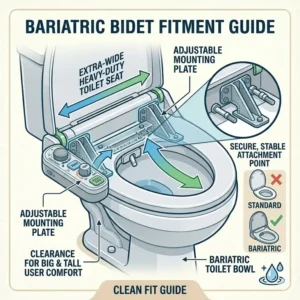
The biggest mistake I see is using the stock plastic mounting bolts. For a bariatric bidet, I always recommend purchasing a set of stainless steel top-mount bolts. Why? Plastic bolts flex. Over a month, that flex leads to “hinge fatigue,” which is how seats eventually crack.
-
Pro-Tip: Before tightening the bolts, sit on the seat to ensure it’s centered. Your body weight will “set” the mounting plate better than your hands ever could.
Phase 2: Dialing in the Reach (Days 4-14)
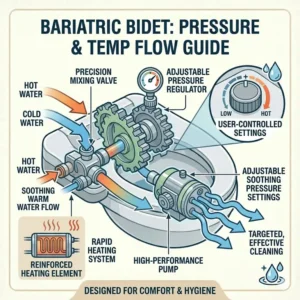
Standard settings are designed for average-sized users. If you find the water isn’t hitting the mark, don’t just lean—adjust the nozzle position via the remote. Most high-end bariatric bidet models allow for 5 stages of nozzle adjustment.
-
Optimization Hack: Use the “Oscillate” function. This moves the nozzle back and forth, covering more surface area and ensuring a “one-and-done” wash cycle.
Phase 3: The Maintenance Rhythm (Day 15 and Beyond)
Bariatric users often require higher water pressure, which can lead to faster mineral buildup in the nozzle. Once a month, use a soft toothbrush dipped in white vinegar to gently scrub the nozzle tip while it’s in “cleaning mode.” This ensures the spray pattern remains consistent and powerful.
Solving the “Side Control Reach” Problem: A Case Study
I once worked with a client, “Robert,” a 450 lb veteran who struggled with his new bariatric bidet. He had purchased a model with side-panel controls, but because of his frame, his thigh completely covered the buttons once he sat down. He had to physically lift himself to find the “Stop” button—not exactly the relaxing experience he was promised.
The Solution:
We swapped the side-panel unit for a remote-controlled model like the Brondell Swash 1400. However, we didn’t just mount the remote to the wall. For Robert, reaching the wall was also a challenge. We used heavy-duty Velcro to attach the remote to a freestanding safety rail right next to his hand.
The Result:
Robert regained full control without shifting his weight.
-
Key Lesson: If you have a wider frame, always opt for a remote-controlled bariatric bidet. It allows you to keep the “command center” in your line of sight or directly in your hand, eliminating the guesswork of “button hunting” under your leg.
Weight Capacity vs. Seat Stability: The Unspoken Reality
When you see a weight rating on a bariatric bidet, it’s usually a “static” rating—meaning it can hold that weight if you sit perfectly still. But humans don’t sit perfectly still. We shift, we lean, and sometimes we “drop” onto the seat. This is where “stability” differs from “capacity.”
A bidet might be rated for 400 lbs, but if the mounting plate is thin plastic, the seat will still “skew” to the side during use. This lateral movement is what actually breaks bidet seats. Look for models that feature “catch-plate” mounting systems. These involve a large square plate that bolts to the toilet first, and then the bidet slides into the plate. This distributes the sheer force across the entire porcelain surface of the toilet, rather than putting all the pressure on two tiny bolt holes.
In my experience, the Bio Bidet and TOTO models have the thickest mounting plates in the industry. If you are on the higher end of the weight spectrum, the mounting plate’s thickness is actually more important than the plastic’s thickness in the seat itself.
Electronic vs. Non-Electric: Which Handles Stress Better?
There is a common myth that non-electric bidets are “tougher” because they have fewer moving parts. While it’s true that a simple T-valve won’t experience a circuit board failure, non-electric bidets are often terrible for bariatric use.
The Problem with Non-Electric:
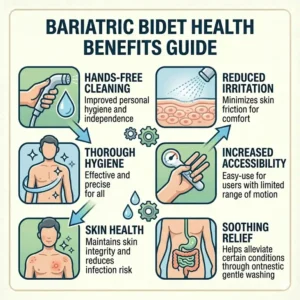
Non-electric models usually use a “cold water” line. For a thorough clean, you might need a 60-second wash. Cold water on sensitive skin for a minute is, frankly, miserable. More importantly, non-electric bidets lack a warm air dryer. For bariatric individuals, moisture trapped in skin folds can lead to dermatitis or fungal infections.
The Electric Advantage:
An electric bariatric bidet provides a powerful, heated air stream. This “active drying” is the single most important feature for maintaining skin integrity. It eliminates the need for abrasive toilet paper and ensures that the area is completely dry before you dress. In the long run, the electrical components are well worth the investment for the preventative health benefits alone.
Common Mistakes When Buying a Bariatric Bidet
After years of troubleshooting, I’ve noticed three recurring blunders that buyers make when searching for a bariatric bidet.
-
Ignoring the “Bolt-Hole” Distance: Most USA toilets have a standard 5.5-inch distance between bolt holes. However, some “designer” toilets have non-standard spacing. If your toilet isn’t standard, a heavy-duty seat simply won’t lock in place correctly, leading to immediate hardware failure.
-
Forgetting the Power Outlet: You can’t run an electric bidet on a standard extension cord. These units draw about 10-12 amps when the heater kicks in. You need a GFCI-protected outlet within 3-4 feet of the toilet. If you have to hire an electrician, factor that “hidden cost” into your budget.
-
Buying “Round” for an “Elongated” Toilet: Bariatric users almost always benefit from an elongated toilet bowl, as it provides more surface area. If you try to put a round bidet on an elongated bowl, you lose about 2 inches of critical support space at the front, which can cause the seat to snap if you sit too far forward.
Features That Actually Matter (And Those That Don’t)
Marketing departments love to add “fluff” features to drive up the price. When you’re looking for a bariatric bidet, you need to filter the noise.
What Actually Matters:
-
Nozzle Oscillation: Moves the water so you don’t have to move your body.
-
Adjustable Water Temp: Essential for comfort and stimulating blood flow.
-
Reinforced Hinges: The #1 point of failure. Metal or high-density polymer is a must.
-
Warm Air Dryer: Critical for skin health and preventing rashes.
What Doesn’t Matter:
-
MP3/Bluetooth Speakers: You’re there to get clean, not host a concert.
-
Fragrance Cartridges: These often just mask odors and can irritate sensitive skin. A good carbon deodorizer (built-in fan) is far more effective.
-
Mobile Apps: Unless you have a specific disability that requires phone-based control, a physical remote is faster and more hygienic.
Long-Term Cost & Maintenance: The ROI Analysis
A high-quality bariatric bidet is an investment, typically costing between $300 and $600. But let’s look at the “Total Cost of Ownership” (TCO) over three years.
-
Toilet Paper Savings: The average person uses about $120 of TP per year. A bidet reduces this by 75-80%. Over 3 years, that’s $280 back in your pocket.
-
Medical Savings: Preventing a single case of skin breakdown or a urinary tract infection (UTI) can save thousands in doctor visits and prescriptions.
-
Water Usage: While it seems counterintuitive, the water used by a bidet is negligible—about 0.1 to 0.3 gallons per wash. This is a fraction of the water used to manufacture a single roll of toilet paper.
Year One Roadmap:
-
Months 1-3: Focus on finding your “perfect” temperature and pressure settings.
-
Month 6: Check the mounting bolts. If they’ve loosened, tighten them. This “Year One” check prevents 90% of seat cracks.
-
Month 12: Replace the carbon deodorizer filter if the model has one.
✨ Don’t Miss These Exclusive Deals!
🔍 Take your bathroom independence to the next level with these carefully selected products. Click on any highlighted item to check current pricing and availability. These tools will help you create a safer, more comfortable home environment!
Conclusion: Reclaiming Independence with the Right Seat
Choosing a bariatric bidet is one of the most practical steps you can take toward better hygiene and bathroom safety. By prioritizing weight capacity, stability, and “active” features like warm air drying, you aren’t just buying a gadget—you’re investing in your long-term health. Whether you opt for the industrial strength of the Bio Bidet HD-7000 or the feature-rich Brondell Swash 1400, the result is the same: a cleaner, more dignified daily routine.
FAQs
❓ Can a standard toilet handle a 500 lb bidet user?
✅ Most modern porcelain toilets are rated for 1,000 lbs of static weight. The toilet itself is rarely the problem; it’s the plastic seat and its hinges that fail. A bariatric bidet reinforces that weak point…
❓ Do I need a special plumber to install a bariatric bidet?
✅ Not at all. Most models use a simple T-valve that screws onto your existing water line. If you can use a wrench, you can install a bidet in about 20 minutes…
❓ What happens if the power goes out?
✅ Most electric bariatric bidet models will not spray water without power. However, some have a manual bypass, and the seat still functions as a standard, sturdy toilet seat…
❓ Is the water pressure high enough for a deep clean?
✅ Yes, especially in models like the Alpha JX. Most heavy-duty units allow you to adjust the pressure across 3 to 5 levels to ensure effectiveness without discomfort…
❓ How do I clean the bidet itself?
✅ Use mild soap and water. Never use harsh abrasives like bleach or scouring pads on the seat, as this can create micro-scratches that harbor bacteria and weaken the plastic…
Recommended for You
- 5 Best Toilet for Obese Person Selections: 2026 Heavy-Duty Review
- 7 Best Folding Commodes of 2026: Expert Reviews & Buying Guide
- 7 Best Bedside Commode Seat Options for Ultimate Safety in 2026!
Disclaimer: This article contains affiliate links. As an Amazon Associate, I earn from qualifying purchases. If you purchase products through these links, we may earn a small commission at no additional cost to you.
✨ Found this helpful? Share it with your friends! 💬🤗
[addtoany]
