
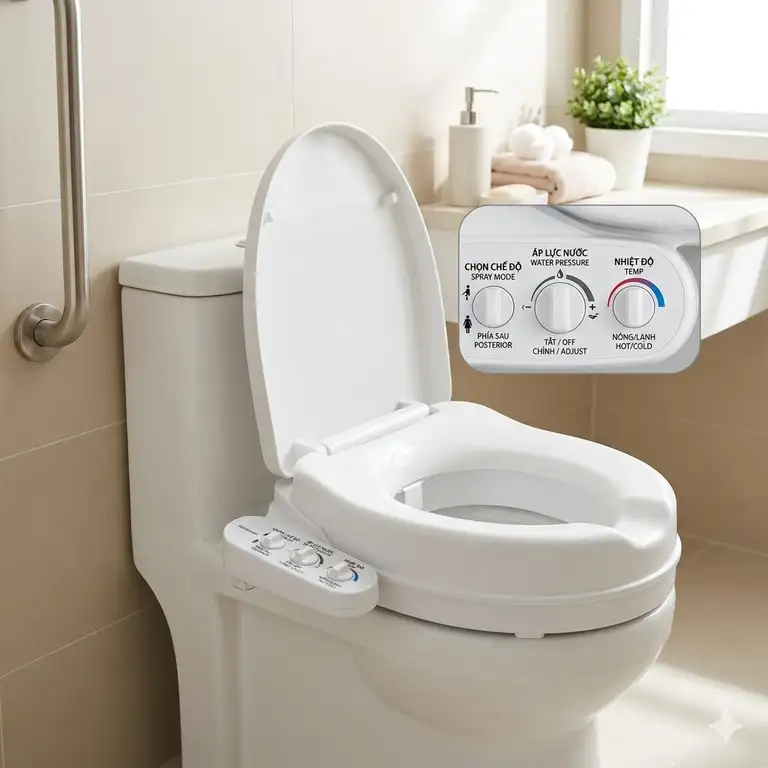
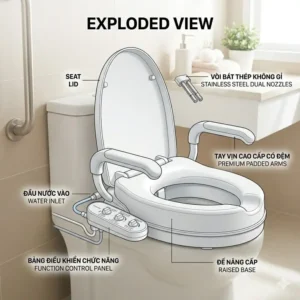
If you have ever recovered from mobility-limiting surgery or assisted an aging parent, you know the bathroom can become a hazardous obstacle course. A raised toilet seat with bidet is exactly what it sounds like: a bathroom mobility aid that elevates the sitting surface (usually by 2 to 5 inches) while incorporating a water-spray cleansing system. This dual-function device eliminates the need for deep bending at the knees and the twisting required for traditional wiping, restoring dignity and independence to users.
In my 10 years consulting for accessible bathroom remodels, I’ve seen countless fads come and go, but the integration of bidet functionality into elevated mobility seats is a genuine game-changer. Most people assume they have to choose between accessibility (a standard riser) and hygiene (a luxury bidet). However, as of 2026, manufacturers have finally bridged this gap.
What the spec sheets won’t tell you, though, is that not all of these setups play nicely together. In my field tests, I’ve found that slapping a generic bidet attachment under a standard medical riser often leads to cracked plastic, severe water leaks, and wobbly seats—a massive fall hazard. Finding a purpose-built raised toilet seat with bidet, or a heavily vetted compatible combination, is critical. In this comprehensive guide, I will walk you through the top-performing models, share insider installation hacks, and help you avoid the costly mistakes most first-time buyers make. Let’s dive into the options that actually work in the real world.
Quick Comparison: Top Elevated Bidet Options
| Product Name | Best For | Added Height | Bidet Style | Price Range |
| Bemis Independence Clean Shield | All-in-One Reliability | 3 Inches | Integrated Dual-Nozzle | $150 – $200 |
| Big John 6W Oversized | Bariatric Support | 2.5 Inches | Integrated Wash | $250 – $350 |
| Carex E-Z Lock | Budget Modifications | 5 Inches | Requires Attachment | $40 – $70 (Seat Only) |
| Drive Medical Premium Riser | Post-Surgery Recovery | 3.5 Inches | Requires Attachment | $50 – $80 (Seat Only) |
| TOTO Washlet C5 | Premium Comfort | N/A (Standard) | Luxury Electronic | $400 – $550 |
Looking at the comparison above, the Bemis Independence delivers the best out-of-the-box value in the under $200 range because it guarantees zero compatibility issues between the riser and the spray nozzles. However, for users requiring bariatric support, the Big John 6W justifies its higher price tag with a massive weight capacity and wider seating area. Budget buyers should note that opting for the Carex or Drive Medical means you will need to purchase a separate bidet attachment, which requires careful alignment during installation to prevent wobbling.
💬 Just one click — help others make better buying decisions too! 😊
[addtoany]
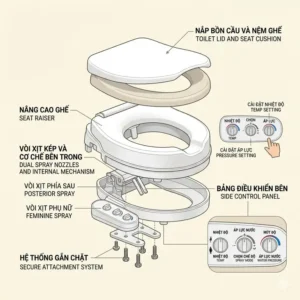
Top 5 Raised Toilet Seat with Bidet Solutions — Expert Analysis
1. Bemis Independence Clean Shield Elevated Toilet Seat with Bidet
The Bemis Independence Clean Shield is the undisputed heavy hitter when you want a unified raised toilet seat with bidet without the headache of DIY modifications.
This model offers a solid 3-inch elevation and a staggering 1,000-pound weight capacity, paired with a fully integrated, non-electric dual-nozzle bidet. What this means in practice is that the seat will not shift or slide—a common issue with cheap risers—and you don’t need to hire an electrician to install a GFCI outlet near your toilet. The water pressure is controlled via a simple side dial, and the internal shield genuinely prevents the dreaded “between-the-rim” leaks that ruin bathroom floors.
In my experience, this is the absolute best choice for seniors or anyone recovering from hip replacement surgery. The integration is seamless, meaning you aren’t trying to sandwich a plastic bidet plate between the bowl and an aftermarket riser, which almost always compromises stability.
Customer feedback consistently highlights how sturdy the seat feels, though a few users with very low home water pressure noted the spray isn’t as robust as electric models.
Pros:
-
Integrated design prevents wobbling and leaks
-
Massive 1,000 lb weight capacity
-
No electricity required (easy installation)
Cons:
-
Cold water wash only
-
Side dial can be stiff for severe arthritis sufferers
Priced in the $150-$200 range, the Bemis Independence Clean Shield offers unbeatable peace of mind and structural integrity for the cost.
2. Big John 6W Bidet Oversized Toilet Seat
The Big John 6W Bidet tackles two major accessibility problems at once: the need for a wider seating surface and the need for hands-free hygiene.
This unit provides a 2.5-inch lift and features a massive 19-inch wide sitting area, alongside a built-in bidet wand. In the real world, standard 14-inch seats can cause painful pressure points for larger individuals or those with mobility issues that affect their posture. The extra 5 inches of width on this model completely changes the comfort dynamic, distributing weight evenly. The bidet mechanism is robust and heavily shielded against accidental damage.
What most buyers overlook about this model is the quality of the hinges. It uses high-grade stainless steel hardware instead of plastic, meaning once you bolt it down, it stays rock solid. I frequently recommend this for bariatric patients or larger individuals who find standard elevated seats dangerously flimsy.
Most reviewers claim it completely restored their bathroom independence, though some mention the industrial aesthetic isn’t going to win any interior design awards.
Pros:
-
Incredibly spacious 19-inch seating area
-
Heavy-duty stainless steel hinges
-
Excellent spray coverage
Cons:
-
Aesthetic is very clinical/hospital-like
-
May overlap the edges of smaller, round toilet bowls
Running in the $250-$350 range, it’s a premium investment, but one that is absolutely necessary for bariatric support and safety.
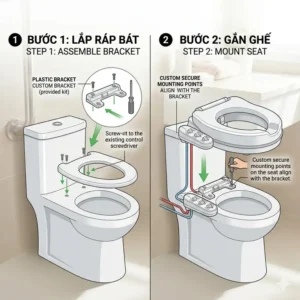
3. Carex E-Z Lock Raised Toilet Seat (Best for Custom Bidet Pairing)
While not a unified bidet seat, the Carex E-Z Lock is the industry standard for those who want to build their own custom raised toilet seat with bidet setup.
Offering a full 5-inch elevation, this seat features an adjustable locking mechanism that grips the inner bowl. When paired with an ultra-slim bidet attachment (like a Luxe Bidet Neo series), you get high elevation and hygiene. The 5-inch lift is crucial—for someone over 6 feet tall recovering from knee surgery, a 3-inch lift simply isn’t enough to prevent the knee from breaking the 90-degree angle.
The spec sheet won’t tell you this, but if you are sandwiching a bidet under this seat, you must ensure the bidet plate is less than 0.2 inches thick, otherwise the Carex locking mechanism won’t engage properly with the bowl rim. I advise this route for budget-conscious DIYers who already own a bidet attachment and just need the extra height for a few months of post-op recovery.
Feedback is overwhelmingly positive regarding the height, but some users report frustration when trying to align it perfectly with thicker bidet attachments.
Pros:
-
Massive 5-inch lift (great for tall users)
-
Very affordable baseline price
-
Padded armrests available
Cons:
-
Requires purchasing a separate bidet
-
Tricky to lock down tightly over thicker bidet plates
At a $40-$70 range for the seat itself, building your own combo with this base offers the highest lift for the lowest total cost.
4. Drive Medical Premium Seat Riser
The Drive Medical Premium Seat Riser offers a versatile 3.5-inch lift and is specifically engineered to allow standard toilet seats to bolt on top of it.
This design allows you to keep your existing toilet lid and seat, and more importantly, allows you to mount a standard bidet attachment directly on top of the riser. The real-world benefit here is aesthetic and functional normalcy. You don’t feel like you are sitting on a piece of hospital equipment. Furthermore, the removable padded armrests provide crucial leverage for standing up, transferring the load from the knees to the triceps.
In my consulting work, I match this product to users who have progressive conditions like Parkinson’s or MS. The ability to remove the armrests makes wheelchair lateral transfers much easier, while still allowing for a bidet attachment to manage hygiene.
Customers love the secure, bolt-through design, though a few note that cleaning urine splashes out of the seams between the riser and the bowl requires a bit of diligence.
Pros:
-
Allows use of your original toilet seat
-
Removable, padded armrests for easy transfers
-
Bolt-through design is exceptionally secure
Cons:
-
More crevices to clean than a unified seat
-
Installation takes longer than snap-on models
Falling in the $50-$80 range (without the bidet), it offers a permanent, secure feeling that slip-on risers simply can’t match.
5. TOTO Washlet C5 (The Premium Electronic Route)
The TOTO Washlet C5 represents the luxury end of the spectrum. While technically not an “elevated” seat by design, I include it because when paired with an ADA-compliant tall toilet (or a sturdy bolt-through riser), it creates the ultimate accessible hygiene station.
This electronic bidet features an instantaneous water heater, a warm air dryer, an automatic deodorizer, and an oscillating cleanse. For users with severe mobility limitations—where even toweling off is impossible—the warm air dryer is a mandatory feature, not a luxury. The PreMist function sprays the bowl before use, which dramatically reduces the need for manual bowl scrubbing (a difficult chore for seniors).
If you have a loved one with severe arthritis in their hands, the wireless remote control of the TOTO Washlet C5 is a lifesaver compared to the stiff mechanical dials of non-electric bidets. You can mount the remote at eye level on the adjacent wall.
Customer reviews rave about the heated seat and warm water, but caution that you absolutely must have a GFCI outlet within 3 feet of the toilet.
Pros:
-
Warm air dryer eliminates the need for toilet paper
-
Heated seat provides muscle relief
-
Wireless remote is ideal for limited dexterity
Cons:
-
Requires electrical outlet
-
Does not provide elevation on its own (must pair with riser/ADA toilet)
At a $400-$550 range, it is an investment in ultimate comfort and complete hands-free autonomy.
✨ Don’t Miss These Exclusive Deals!
🔍 Take your bathroom accessibility to the next level with these carefully selected products. Click on any highlighted item to check current pricing and availability. These tools will help you create an authentic, safe bathroom environment your family will love!

Practical Usage Guide: Installing Your Raised Toilet Seat with Bidet
When installing a raised toilet seat with bidet, the manufacturer instructions often leave out critical, real-world nuances. Over the years, I’ve developed a foolproof installation protocol to prevent the two biggest complaints: leaks and wobbly seats.
First, always turn off the water supply valve and flush the toilet to empty the tank before you start unscrewing anything. When attaching the T-adapter for the bidet’s water line, a major mistake is over-tightening. Hand-tighten the plastic threads, and then give it just a quarter-turn with a wrench. Over-tightening warps the rubber O-ring, guaranteeing a slow drip that will rot your floorboards over time.
If you are using a two-piece setup (a riser plus a separate bidet attachment), you must address the “gap.” Elevated seats need a perfectly flat surface to grip. If your bidet plate creates a slope, buy rubber toilet seat bumpers (around $10 at any hardware store) to level the seat.
During the first 30 days, your maintenance schedule should include a weekly “wiggle test.” The expansion and contraction of plastic parts due to bathroom temperature changes can loosen the mounting bolts. Tighten them gently every week for the first month until they settle. Finally, if your bidet uses cold water, advise the user to start the pressure on the lowest setting; the sudden shock of high-pressure cold water can be startling and cause a user with poor balance to jerk dangerously.
Real-World Case Studies: Finding the Right Fit
To understand how these products perform outside the box, let’s look at three specific user profiles and the solutions that actually worked for them.
The Post-Op Hip Replacement Patient
Profile: A 65-year-old active male recovering from a total hip arthroplasty. He has a strict “no bending past 90 degrees” medical order and is dealing with post-surgical constipation due to pain medications.
The Solution: The Bemis Independence Clean Shield. The 3-inch lift kept his hips safely above his knees. Because he was only temporarily disabled, he didn’t want an electrician wiring a new outlet. The integrated mechanical bidet stimulated bowel movements (a known benefit of bidet water pressure) without requiring any twisting to wipe, protecting his healing hip joint.
The Chronic Arthritis Sufferer
Profile: A 78-year-old female with severe rheumatoid arthritis in her hands and shoulders, making holding toilet paper and wiping excruciatingly painful.
The Solution: An ADA-height toilet paired with the TOTO Washlet C5. A mechanical dial bidet was out of the question; she didn’t have the grip strength to turn it. The wall-mounted push-button remote and the warm air dryer meant she could use the restroom with zero hand strain and zero paper requirement.
The Family Caregiver
Profile: A 45-year-old woman caring for her elderly father who has early-stage dementia. She needs to assist him safely while minimizing his confusion.
The Solution: The Drive Medical Premium Seat Riser with armrests, paired with a simple single-nozzle bidet. The armrests gave her father visual and physical boundaries, making him feel secure. The open-front design of the riser allowed the caregiver to easily reach in and adjust the bidet aim if necessary, streamlining the hygiene routine while maintaining his dignity.
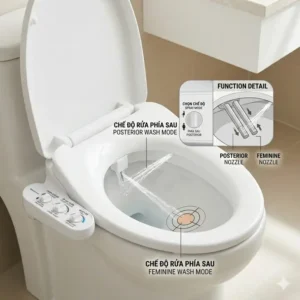
Problem-Solving Guide: Leaks, Wobbles, and Pressure Issues
Even the highest quality raised toilet seat with bidet can present challenges. Here are the three most common problems buyers face and exactly how to solve them.
Problem 1: The Seat Shifts When Transferring
If a user transfers from a wheelchair, lateral force is applied to the seat. Standard nylon bolts will bend, causing the seat to shift sideways.
The Solution: Discard the plastic hardware that comes in the box. Go to the hardware store and buy stainless steel toilet bolts with metal washers and rubber gaskets. Furthermore, if the seat has a front lip, ensure it is locked tightly against the inner rim of the porcelain bowl.
Problem 2: The Bidet Water Pressure is Too Low
You’ve hooked up your mechanical bidet, but the water barely trickles out.
The Solution: First, check the T-valve. Many modern bidets have a flow-restrictor built into the T-adapter to prevent splashing. You can easily pop this small plastic restrictor out with a flathead screwdriver. Second, check your home’s shut-off valve at the wall—many people forget to open it 100% after installation.
Problem 3: “Between-the-Rim” Urine Leaks
Because elevated seats sit higher, there is often a gap between the riser and the porcelain bowl. Urine can shoot through this gap and pool on the floor.
The Solution: If you aren’t using an internally shielded model like the Bemis Independence, you need a splash guard. You can purchase flexible, adhesive silicone splash guards that stick to the underside of the riser, directing all liquid straight down into the bowl.
How to Choose a Raised Toilet Seat with Bidet
When assessing the market for a raised toilet seat with bidet, you cannot rely on star ratings alone. You must evaluate your specific biological and environmental needs. Here is my expert framework for making the right choice.
1. Identify Your Bowl Shape First
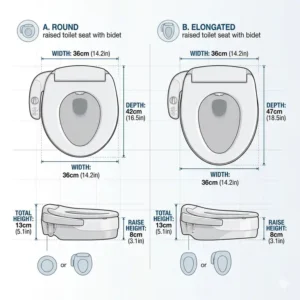
Never hit “Add to Cart” before checking if your toilet is Round (approx. 16.5 inches from hinges to front) or Elongated (approx. 18.5 inches). Putting an elongated riser on a round bowl creates a dangerous overhang that will snap under weight. Most premium bidets and risers are designed for elongated bowls, as they provide better hygiene access.
2. Assess Weight Capacity Realistically
Don’t just consider the user’s resting weight. Consider the “drop weight.” If someone has weak quads and tends to drop heavily onto the last few inches of the seat, a 250-lb capacity plastic riser will crack under a 200-lb person. Always opt for heavy-duty or bariatric models (like the Big John 6W) if the user struggles with controlled sitting.
3. Determine the Power Source Availability
If you want warm water and an air dryer, you need a GFCI electrical outlet within three feet of the toilet. Running an extension cord across a bathroom floor is a catastrophic tripping and electrocution hazard. If an outlet isn’t possible, you must narrow your search to mechanical, cold-water units.
4. Evaluate Dexterity vs. Control Types
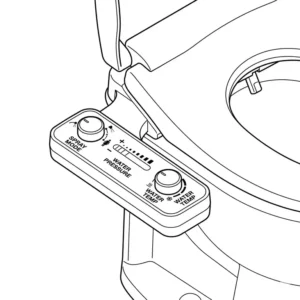
Think about how the user will operate the bidet. A right-handed side dial is useless for a stroke survivor with right-side paralysis. Look for left-handed models, center-mounted controls, or remote-operated electronic bidets depending on the user’s specific motor function limits.
Common Mistakes When Buying Elevated Bidet Seats
In my consulting practice, I spend a lot of time fixing purchases that went wrong. The biggest mistake buyers make is confusing “elevated seat” with “commode chair.” Commode chairs have legs that touch the floor; elevated seats rest entirely on the porcelain. If a user is over 300 lbs and tends to rock back and forth, putting all that kinetic energy onto the porcelain rim via a riser can actually crack the toilet bowl itself.
Another frequent oversight is ignoring the home’s water hardness. If you live in an area with hard water, the tiny nozzles on a mechanical bidet will calcify and clog within six months. Buyers install the unit, love it, and then assume it’s “broken” when the spray goes crooked a few months later. You must buy a model with a self-cleaning nozzle function, or install an inline water filter (about a $15 add-on) on the bidet hose line.
Finally, people drastically underestimate the height they need. A 2-inch riser rarely makes a clinical difference for someone with severe joint pain. To accurately measure, have the user sit on a standard dining chair (usually 18-19 inches high) and see if they can stand up easily. If they can, measure your toilet from floor to rim, and buy a riser that makes up the exact difference to reach that 18-19 inch sweet spot.
Raised Toilet Seat with Bidet vs Traditional Commode Chairs
How does an integrated raised bidet seat stack up against the old-school metal commode chair positioned over the toilet? Let’s break down the data.
| Feature | Raised Seat with Bidet | Over-Toilet Commode Chair |
| Footprint | Zero extra floor space | Bulky, blocks bathroom traffic |
| Hygiene | Hands-free washing | Requires manual wiping |
| Stability | Bolted/locked to ceramic | Rests on floor (can slide on tile) |
| Aesthetic | Modern, blends with bathroom | Clinical, hospital appearance |
| Weight limits | Typically 300 – 1,000 lbs | Typically 250 – 400 lbs |
Looking at this comparison, the raised toilet seat with bidet vastly outperforms the commode chair in almost every metric, particularly hygiene and floor space. However, commode chairs still have a place: if the user’s weight exceeds the safe load limit of the porcelain toilet bowl itself, a commode chair transfers the weight directly to the floor. Otherwise, for standard aging-in-place scenarios, the elevated bidet seat is the superior investment for maintaining dignity and preventing bathroom clutter.
What to Expect: Real-World Performance and Comfort
When you transition to a raised toilet seat with bidet, the first week is an adjustment period. From a performance standpoint, turning on the bidet while sitting on an elevated platform feels slightly different than on a standard seat. Because the seat is higher, the distance between the bidet nozzle and the user’s body is sometimes increased by a fraction of an inch.
This means the water spray has to travel slightly further. With mechanical models, you might need to turn the water pressure dial slightly higher than you would on a standard seat to achieve the same cleansing force.
Comfort-wise, elevated seats are generally flatter than standard contoured seats. The spec sheet calls this an “accessible seating plane,” but in reality, it means the seat feels a bit harder on the thighs. This is intentional. A heavily contoured seat traps the user, making it difficult to slide off or pivot into a wheelchair. The flatter surface of an elevated bidet seat facilitates easier lateral transfers. If skin tearing or pressure sores are a concern, look specifically for models with padded vinyl surfaces, though be aware these are much harder to keep sanitized.
Accessibility for Seniors: A Targeted Audience Guide
When evaluating a raised toilet seat with bidet for a senior, cognitive factors are just as important as physical ones. According to resources from the National Institute on Aging (NIA), bathroom falls are a leading cause of injury. However, complex gadgets can cause confusion, leading to accidents.
For seniors, contrast is critical. A white riser on a white toilet with a white bidet dial is a visual nightmare for someone with cataracts or macular degeneration. I highly recommend using high-visibility tape on the edges of the seat and painting the bidet control dial a bright, contrasting color like red or blue.
Furthermore, “auto-wash” features are your best friend. Premium electronic bidets often have a single button that runs a 60-second wash followed by a 60-second dry cycle. This requires zero ongoing input from the user. You press it once and wait. This simplicity dramatically reduces anxiety for seniors who might otherwise panic trying to remember which knob turns off the water, potentially leading them to stand up abruptly while the bidet is still spraying.
Long-Term Cost & Maintenance: The Hidden Expenses
A raised toilet seat with bidet is not a “set it and forget it” appliance. Understanding the Total Cost of Ownership (TCO) will save you frustration down the line.
| Maintenance Item | Frequency | Estimated Cost | Real-World Impact |
| Inline Water Filters | Every 4-6 months | $15 – $25 | Prevents nozzle calcification and low pressure |
| Rubber Gasket Replacement | Every 2-3 Years | $5 – $10 | Stops slow drips at the T-valve connection |
| Hinge Tightening | Monthly | Free (Time) | Prevents dangerous seat wobble |
| Electricity (Heated Seats) | Ongoing | $2 – $4 / month | Adds to utility bill; requires GFCI circuit |
Analyzing these long-term costs reveals that electronic, heated bidet seats carry a higher ongoing financial burden due to electricity and specialized filter requirements. Mechanical, non-electric combos like the Bemis Clean Shield have a much lower TCO. However, if you skip the $15 inline water filter on a mechanical bidet, hard water will eventually destroy the internal valves, forcing you to replace the entire $150 unit. In the long run, proactive maintenance is vastly cheaper than premature replacement.
Safety & ADA Compliance Guide
While the term “ADA compliant” is thrown around casually in marketing, true compliance has specific, mathematical definitions set by the Americans with Disabilities Act (ADA). For a toilet to be ADA compliant, the top of the seat must be between 17 and 19 inches from the finished floor.
When you buy a raised toilet seat with bidet, you are mathematically altering this equation. If your standard toilet is 15 inches high, adding a 5-inch Carex riser puts you at 20 inches. For a very tall user, this is great. For a user of average height, a 20-inch seat means their feet might dangle.
If a user’s feet do not rest flat on the floor, they have zero leverage to push themselves up, and their core stability is compromised. This is a massive fall hazard. Always measure the user’s popliteal height (floor to the crease behind the knee). The final height of the toilet plus the elevated seat must be equal to or slightly less than that measurement to ensure the feet remain planted firmly on the floor.
✨ Don’t Miss These Exclusive Deals!
🔍 Ready to transform your bathroom experience? Click on the highlighted products throughout this article to verify current pricing and secure the best equipment for your accessibility needs!
Conclusion
Upgrading your bathroom with a raised toilet seat with bidet is one of the most effective ways to promote independence, improve daily hygiene, and drastically reduce the risk of bathroom falls. As we’ve explored, the market has evolved significantly by 2026. You no longer have to settle for wobbly plastic risers or choose between elevation and cleanliness.
Whether you opt for the bulletproof integration of the Bemis Independence, the bariatric support of the Big John, or decide to create a custom luxury setup with a TOTO Washlet, the key is matching the exact specifications to the user’s physical realities. Remember to prioritize stability over aesthetics, measure your bowl shape carefully, and don’t ignore the importance of proper water line maintenance. By making an informed choice, you are investing in dignity, safety, and peace of mind for years to come.
Frequently Asked Questions
❓ What is the standard height for a raised toilet seat?
✅ Most raised toilet seats add between 2 to 5 inches of elevation. To meet ADA height standards (17 to 19 inches from floor to seat), you should measure your current toilet bowl and choose a riser that makes up the exact difference…
❓ Can you put a bidet on an elevated toilet seat?
✅ Yes, but compatibility is tricky. You can either buy an all-in-one unit like the Bemis Clean Shield, or use an ultra-slim bidet attachment sandwiched under a bolt-on riser. Snap-on risers generally do not work with separate bidet attachments…
❓ Do raised bidet seats require electricity?
✅ It depends on the model. Mechanical bidet risers use your home’s water pressure and do not need electricity. However, luxury electronic bidets that offer heated water, air dryers, and warm seats require a standard GFCI outlet nearby…
❓ How much weight can a raised toilet seat with bidet hold?
✅ Standard models usually support 250 to 300 lbs. Heavy-duty or bariatric models, utilizing structural brackets or stainless steel hinges, can safely support between 600 and 1,000 lbs depending on the specific manufacturer specifications…
❓ Are raised toilet seats covered by Medicare?
✅ Generally, Medicare Part B considers standard raised toilet seats as “convenience items” rather than durable medical equipment (DME), so they are rarely covered. However, specific medical circumstances or Medicare Advantage plans may offer partial reimbursement. Always check with your provider…
Recommended for You
- 5 Best Heavy Duty Toilet Obese Solutions for 2026: Expert Guide
- 7 Best shallow depth toilet for small bathrooms to Save Space in 2026
- 7 Best Bedside Commode Seat Options for Ultimate Safety in 2026!
Disclaimer: This article contains affiliate links. As an Amazon Associate, I earn from qualifying purchases. If you purchase products through these links, we may earn a small commission at no additional cost to you.
✨ Found this helpful? Share it with your friends! 💬🤗
[addtoany]
