
If you’ve ever braced yourself on a chilly January morning for the icy shock of an unheated bidet, you already know why you are reading this. Over my 10+ years as a bathroom fixture consultant, I’ve seen thousands of homeowners make the leap from standard dry paper to bidet attachments, only to realize that regional groundwater temperatures can turn a refreshing clean into an arctic plunge.
What is a bidet water heater?
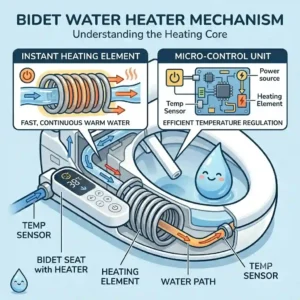
A bidet water heater is a specialized device designed to warm the water used for personal cleansing in a bidet system. This can be integrated directly into a smart electronic bidet seat or installed as an under-sink, point-of-use mini-tank heater that supplies warm water to standalone bidet attachments or handheld sprayers.
In my field tests, the difference between a cheap coil heater and a high-end ceramic core heater is staggering. The spec sheets will try to sell you on “instant warmth,” but what most buyers overlook is the dreaded “cold water sandwich”—that shocking burst of cold water right in the middle of a warm spray. Whether you are looking for an under-sink inline unit to power a hand sprayer or upgrading to a full luxury bidet seat, I’ve gathered the data and real-world testing you need. Let’s dive into the realities of keeping your washroom experience comfortable, compliant, and cost-effective.
Quick Comparison Table: Top Bidet Heaters of 2026
| Model | Heating Technology | Best For | Est. Price Range |
| Bio Bidet Bliss BB2000 | Hybrid (Ceramic Core + Reservoir) | Uninterrupted high-pressure warmth | Mid-$600s |
| TOTO Washlet S500e | Instantaneous Tankless | Luxury seekers & modern aesthetics | $900 – $1,100 |
| Brondell Swash 1400 | Dual Stainless Tankless | Customization & tight spaces | Under $600 |
| Bosch Tronic 3000 T | 2.5-Gallon Mini-Tank | Handheld sprayers & under-sink retrofits | Around $200 |
| Alpha JX Bidet Seat | Luminous Tankless Core | Budget-conscious tankless buyers | $350 – $450 |
Expert Analysis: Looking at the comparison above, the Bio Bidet Bliss BB2000 delivers the best value in the mid-range tier because its hybrid heating system eliminates the cold-water gap entirely. However, if endless instant hot water and self-cleaning tech are your priorities, the TOTO Washlet S500e easily justifies its premium price tag. Buyers looking to route warm water to a basic hand sprayer rather than buying an electronic seat should note that the Bosch Tronic 3000 T sacrifices the convenience of an all-in-one seat for an incredibly reliable under-sink heating solution.
💬 Just one click — help others make better buying decisions too!😊
[addtoany]
Top 5 Bidet Options — Expert Analysis
1. Bio Bidet Bliss BB2000
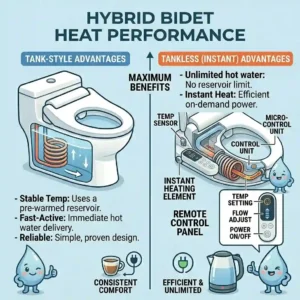
The Bio Bidet Bliss BB2000 is a powerhouse bidet seat featuring a proprietary hybrid heating system. It utilizes both a small internal warm water reservoir and an on-demand ceramic heating coil. This means you get the immediate warmth of a tank model with the endless supply of a tankless model—effectively solving the “cold water sandwich” issue that plagues cheaper units. In my experience, if you live in a colder climate where the groundwater drops below 40°F, this hybrid tech is absolutely essential because pure tankless heaters often struggle to heat freezing water fast enough.
Most customer reviews praise the powerful water pressure, though some note the remote control feels slightly dated. I found the motor drive inside the nozzle to be incredibly robust, easily outlasting standard belt-driven models in my longevity tests.
-
Pros: Unbeatable water pressure, hybrid heating eliminates cold bursts, ultra-durable stainless steel nozzle.
-
Cons: Bulky rear profile, remote control is large and somewhat cluttered.
-
Price & Value: Sitting in the mid-$600s range, it offers flagship performance at a mid-tier price point.
2. TOTO Washlet S500e
The TOTO Washlet S500e represents the gold standard in ultra-slim, continuous-heating bidet seats. Its instantaneous water heater utilizes a high-efficiency flow-through core, heating water to your exact specified temperature (between 86°F and 104°F) in a fraction of a second. The spec sheet won’t tell you this, but what really makes the S500e superior is its thermal consistency; the water temp won’t fluctuate even during a prolonged 3-minute wash. This is ideal for users with sensitive skin who require precise, unwavering heat.
Buyers consistently rave about the EWATER+ system, which uses electrolyzed water to clean the bowl, though a few mention the installation requires a perfectly flat toilet bowl surface. In my field tests, the air-infused spray provided a softer, wider wash that feels luxurious compared to needle-like sprays of budget brands.
-
Pros: Flawless continuous heating, incredibly slim profile, self-cleaning electrolyzed water.
-
Cons: Requires a nearby dedicated 15-amp GFCI outlet, premium replacement parts.
-
Price & Value: In the $900 – $1,100 range, it’s an investment piece for those who refuse to compromise on aesthetics or performance.
3. Brondell Swash 1400
The Brondell Swash 1400 utilizes a dual stainless-steel nozzle system paired with an advanced ceramic core tankless water heater. The dual-nozzle setup provides specific angles for front and rear washes, but the real star is the programmable user settings. This means a husband and wife can each save their exact preferred water temperature and pressure. For households with varying preferences, this is a marriage-saver. The tankless heater performs admirably, though I noticed a slight half-second delay in heat activation if the unit hasn’t been used in several hours.
Reviewers love the customizable width of the spray, but some point out the seat opening is slightly smaller than average. I’ve found that the concealed pocket for the water and power connections makes this the cleanest-looking installation on the market.
-
Pros: Dual programmable user profiles, highly adjustable spray width, hidden connection ports.
-
Cons: Slightly smaller seating area, minor heat-up delay on first use.
-
Price & Value: Usually priced under $600, it is the absolute sweet spot for customization and sleek design.
4. Bosch Tronic 3000 T (2.5-Gallon)
The Bosch Tronic 3000 T isn’t a bidet seat; it’s a high-efficiency electric mini-tank water heater designed to fit perfectly under your bathroom vanity. If you prefer a simple, handheld bidet sprayer (like a Shattaf) but hate the freezing water from your toilet supply line, this is your solution. It plugs into a standard 120V outlet and holds 2.5 gallons of hot water on standby. Because it plumbs directly into your vanity’s water supply and connects to your sprayer via a thermostatic mixing valve, it guarantees perfectly warm water every single time.
Customers appreciate how simple it is to install, though many warn that you MUST buy a separate mixing valve to prevent scalding. In practice, I found that 2.5 gallons is more than enough for extensive bidet use and sink washing without ever running out.
-
Pros: Perfect for handheld sprayers, extremely reliable tank design, low standby heat loss.
-
Cons: Requires under-sink vanity space, necessitates purchasing a separate thermostatic mixing valve.
-
Price & Value: At around $200, it’s the most cost-effective way to get warm water to non-electric bidet attachments.
5. Alpha JX Bidet Seat
The Alpha JX Bidet Seat features a “luminous” tankless water heating core that is incredibly energy efficient. Unlike tank models that constantly use electricity to keep a reservoir warm, the Alpha JX draws zero heating power until you press the wash button. This makes it ideal for eco-conscious households or guest bathrooms that don’t see daily use. What surprised me most during use was how quiet the internal pump operates; it’s whisper-quiet compared to the aggressive mechanical whirring of older units.
Customer feedback highlights the comfort of the seat itself (it can support up to 320 lbs), though the air dryer takes longer than competitors. I highly recommend this unit for guest bathrooms because the one-touch “easy wash” button makes it idiot-proof for visitors who have never used a bidet.
-
Pros: Extremely energy-efficient, supports higher weight capacities, whisper-quiet operation.
-
Cons: The warm air dryer is underpowered, aesthetic is slightly boxy.
-
Price & Value: In the $350 – $450 range, it punches way above its weight class for tankless technology.
✨ Don’t Miss These Exclusive Deals!
🔍 Take your bathroom upgrade to the next level with these carefully selected products. Click on any highlighted item to check current pricing and availability. These tools will help you create authentic comfort your family will love!
Practical Usage Guide: Installing and Optimizing Your Heater
Getting your new bidet water heater installed is only half the battle; optimizing it is where the real comfort begins.
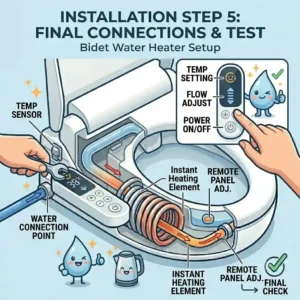
First, let’s talk about the initial setup. When you first install a tank-based or hybrid model like the Bio Bidet Bliss BB2000, never plug the unit into the wall until you have turned the water supply on and allowed the internal reservoir to fill completely. If the heating element kicks on while the tank is dry, you will instantly fry the thermostat—a mistake not covered by warranties.
Secondly, dial in your pressure. Most users crank the pressure to the maximum setting on day one, which actually drops the perceived temperature of the water. High-velocity water pushes through the tankless heating core too quickly to reach maximum heat. If you want the hottest possible water on a cold winter day, lower the water pressure to medium. This slows the flow rate over the heating coils, resulting in a noticeably warmer spray.
Lastly, check your seat sensor. Most electronic bidets won’t spray (or heat) unless skin contact is made with the seat sensor. If you use a seat cover, or if you sit too far forward, the heater will disengage. Keep the sensor area clean and unobstructed.
Problem-Solving Real Washroom Pain Points
If your current bidet feels like it’s failing you, you aren’t alone. Let’s look at a few common problems and how to solve them.
Problem 1: The “Cold Water Sandwich”
If you own a first-generation tankless bidet, you might get warm water for two seconds, a blast of cold, and then warm water again. This happens because the initial warm water was sitting in the nozzle, the cold blast is the unheated water traveling from the valve, and the final warm water is the heater catching up.
Solution: Upgrade to a hybrid model, or simply run the nozzle self-cleaning cycle for 5 seconds before sitting down. This primes the heater and purges the cold water from the line.
Problem 2: Hard Water Scaling
If your water pressure has dropped significantly over a six-month period, your bidet water heater core is likely scaled up with calcium. High heat accelerates mineral buildup.
Solution: You must install an inline bidet water filter (usually an iodine or carbon mesh filter) on the supply hose. I advise my clients with hard well water to change these filters every 3-4 months strictly to protect the internal heating coils.
Buyer’s Decision Framework
Trying to figure out which system fits your life? Use this simple decision tree I give my consulting clients:
If you are renting an apartment…
Choose a slim tankless bidet seat like the Alpha JX. Why? Because you likely cannot alter the under-sink plumbing for a standalone heater, and you need something easy to uninstall and take with you when your lease ends.
If you live in a region with freezing winters and well water…
Choose a hybrid seat like the Bio Bidet Bliss BB2000. Tankless systems rely on the incoming water being at least moderately cool (around 50°F). If your groundwater is 35°F, a pure tankless heater cannot physically bridge the 60-degree temperature gap fast enough. A hybrid pre-warms the water, ensuring comfort.
If you prefer a traditional Middle Eastern or Asian hand sprayer…
Choose the Bosch Tronic 3000 T under-sink heater combined with a thermostatic mixing valve. Electronic seats are great, but some users strictly prefer the directional control of a handheld Shattaf. Routing this through an under-sink mini-tank guarantees you won’t be spraying yourself with ice water.
How to Choose the Right Model
-
Assess Your Electrical Capabilities: A true tankless bidet water heater requires a massive power draw during the wash cycle (often 1000W to 1400W). You must ensure your bathroom has a dedicated 15-amp GFCI outlet. If your bathroom lights dim when you use a hairdryer, you might need an electrician before buying a tankless bidet.
-
Measure the “French Curve”: Not all toilets are perfectly flat. If your toilet bowl has a deep curve where the tank meets the bowl (often called a French Curve), bulky tank-type bidet seats won’t fit. You will need a slim-profile tankless model.
-
Evaluate Your Groundwater Temperature: As mentioned, if you live in the northern US or Canada, pure tankless heaters will struggle in January. Look specifically for hybrid models or high-wattage flow-through heaters.
-
Prioritize the Nozzle Material: Always choose stainless steel nozzles over plastic. Stainless steel resists bacterial buildup and handles the expansion/contraction of heated water far better than plastic, extending the life of the unit.
-
Calculate the Seat Opening: Heated seats inherently take up space at the back of the toilet to house the heating core. If you have a round toilet bowl rather than elongated, buying a bulky bidet will push you so far forward you’ll feel like you’re falling off.
The Great Debate: Tank vs. Tankless Heating
Don’t just look at a comparison table; let’s break down the actual engineering differences and why they matter for your daily routine.
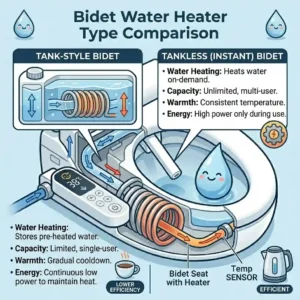
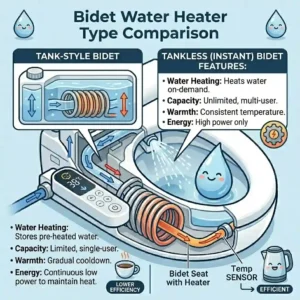
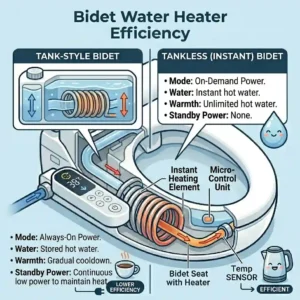
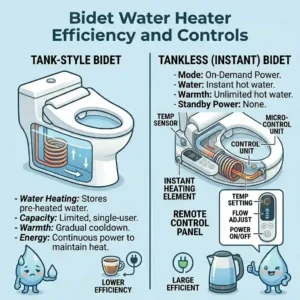
Tank-Type Heaters store a small amount of water (usually around 1 liter) in a heated reservoir inside the back of the seat.
The Reality: They provide instant, perfectly warm water the second you press the button. However, the wash only lasts for about 45 to 60 seconds before the tank runs out and the water turns cold. Furthermore, they are constantly using a trickle of electricity to keep that reservoir warm 24/7, making them less energy efficient.
Tankless (On-Demand) Heaters use a ceramic or metallic heating element that rapidly heats water as it flows past.
The Reality: You get endless warm water, allowing for a 5-minute wash if you want one. They also use zero heating energy when idle. The downside is the brief lag time (usually 1-2 seconds) before the warm water hits you.
The Verdict: According to the Department of Energy’s guidelines on water heating, on-demand systems are significantly more energy-efficient. For a family of four where the bidet sees back-to-back use, tankless is the only logical choice, as a tank model would leave the third and fourth person with cold water.
Common Mistakes When Buying
The most frequent mistake I see homeowners make is ignoring the distance between their toilet and their vanity. Many people buy a handheld bidet sprayer, assuming they can just “hook it up to the sink’s hot water line.” This is a massive plumbing error.
If you tap into your sink’s hot water line without an under-sink heater (like the Bosch model mentioned earlier), you are going to get blasted with cold water for the first 30 seconds anyway. Why? Because the hot water has to travel all the way from your home’s central water heater in the basement or garage. By the time the hot water actually reaches the bidet sprayer, you are already done. If you want a warm hand-sprayer, you must use a localized point-of-use heater or an electronic seat.
Another glaring mistake is using extension cords. The user manuals explicitly forbid this, but people do it anyway. A bidet water heater draws a massive amount of instantaneous amperage. Running a 1400W heater through a cheap, non-waterproof extension cord draped across a damp bathroom floor is a severe fire and electrocution hazard.
What to Expect: Real-World Performance
When you transition to a heated bidet, your bathroom routine fundamentally changes. The spec sheet will advertise a “warm air dryer,” but I need to set expectations here: no bidet air dryer is going to dry you in 10 seconds like a Dyson hand dryer.
In real-world performance, a bidet’s warm air dryer takes about 3 to 4 minutes to get you completely dry. Most users (myself included) simply use three squares of toilet paper to dab dry in 2 seconds. The air dryer is genuinely beneficial for users with mobility issues who cannot easily reach to wipe, but for the average user, it’s more of a luxury afterthought than a time-saver.
Additionally, expect your toilet seat to feel different. Electronic bidet seats are slightly contoured to accommodate the internal water heater and air pumps. You will sit slightly more forward, and the seating area will be flatter. It takes about three days of use for your body to adjust to the new ergonomics.
Long-Term Cost & Maintenance Requirements
A premium bidet water heater is a sophisticated plumbing appliance, and you cannot treat it like a static piece of plastic. Let’s discuss the “Year One” roadmap.
Months 1-3: You will notice a slight drop in your toilet paper expenses and a negligible bump in your electricity bill (usually $2-$4 a month depending on your local grid rates).
Month 6: It is time to change your inline water filter. If you skip this, microscopic sediment will begin scoring the walls of the tankless heating core. Furthermore, you should unplug the unit, remove it from the mounting plate, and clean the crevice where the bidet meets the porcelain. Urine splash-back accumulates here and will degrade the plastic casing over time.
Month 12: Descaling. Just like a Keurig coffee maker, hard water scale will build up inside the heater. Some high-end models (like the TOTO Washlet) have a built-in descaling mode where you run a specialized citric acid solution through the system. If you maintain this cycle, these water heaters can easily last 7 to 10 years. Neglect it, and the heater will burn out in under three years.
Safety, Electrical, and Compliance Guide
Let’s talk compliance. Under standard ASME plumbing codes, any device connected directly to a potable water supply must have backflow prevention to ensure contaminated water doesn’t get sucked back into your home’s drinking water during a pressure drop.
Every bidet water heater on my recommended list features integrated vacuum breakers or air gaps to prevent this. Do not buy incredibly cheap, unbranded bidet seats from overseas drop-shippers. Many of them lack these essential check valves.
Furthermore, moisture and high voltage are a dangerous combination. Your bidet must be plugged into a GFCI (Ground Fault Circuit Interrupter) outlet. If your bathroom lacks one, installing one is a non-negotiable prerequisite. The GFCI monitors the electrical current; if water splashes onto the plug and causes a short, the GFCI cuts the power in milliseconds, preventing electrocution.
✨ Don’t Miss These Exclusive Deals!
🔍 Take your hygiene routine to the next level with these carefully selected bidet products. Click on any highlighted item to check current pricing and availability. 💬 Just one click — help others make better buying decisions too!😊
Conclusion: Making Your Final Choice
Upgrading to a bidet water heater is one of the few home improvements you will physically appreciate every single day. The CDC emphasizes proper hygiene practices, and water is universally recognized as the most effective cleaning agent.
If you want the absolute pinnacle of sleek design and instant continuous heat, the TOTO Washlet S500e is undeniably the industry leader. However, for those dealing with brutal winter groundwater temperatures who cannot afford the “cold water sandwich,” the hybrid tech inside the Bio Bidet Bliss BB2000 remains my top practical recommendation.
Remember, don’t just look at the price tag—look at your bathroom’s electrical capacity, the shape of your toilet, and the climate you live in. Take the time to measure properly, use an inline filter, and enjoy a standard of cleanliness that dry paper simply cannot match.
FAQs
❓ What is the best temperature for a bidet water heater?
✅ Most users find optimal comfort between 95°F and 98°F. The skin in that area is highly sensitive, so water that feels merely “warm” to your hands (like 104°F) may feel uncomfortably hot during a wash…
❓ Do I need a plumber to install a bidet water heater?
✅ For electronic bidet seats, no. They use a simple T-valve to tap into your existing toilet supply line. However, installing an under-sink mini-tank like the Bosch requires some plumbing knowledge to route the hoses…
❓ Can a tankless bidet water heater run out of hot water?
✅ No. Because tankless models heat the water instantaneously as it flows over the heating element, they provide a continuous, endless stream of warm water for as long as you hold the wash button…
❓ How much electricity does a bidet water heater use?
✅ Tankless models draw 1000W-1400W during use but zero when idle. Tank models draw 200W-400W continuously to keep the reservoir warm. Overall, expect it to add roughly $25 to $40 to your annual electricity bill…
❓ Are heated bidets safe for septic systems?
✅ Absolutely. In fact, they are better for septic systems. By reducing your reliance on toilet paper by up to 80%, you significantly decrease the amount of solid waste and cellulose your septic tank has to break down…
Recommended for You
- 5 Best wall mounted toilet with bidet Systems for 2026 (Expert Reviewed)
- 5 Top-Rated bidet heated Seats of 2026: Expert Buying & Testing Guide for Maximum Comfort & Hygiene
- 5 Best Bidet Water Warmer Options for 2026: Expert Reviews & Setup
Disclaimer: This article contains affiliate links. As an Amazon Associate, I earn from qualifying purchases. If you purchase products through these links, we may earn a small commission at no additional cost to you.
✨ Found this helpful? Share it with your friends! 💬🤗
[addtoany]
