
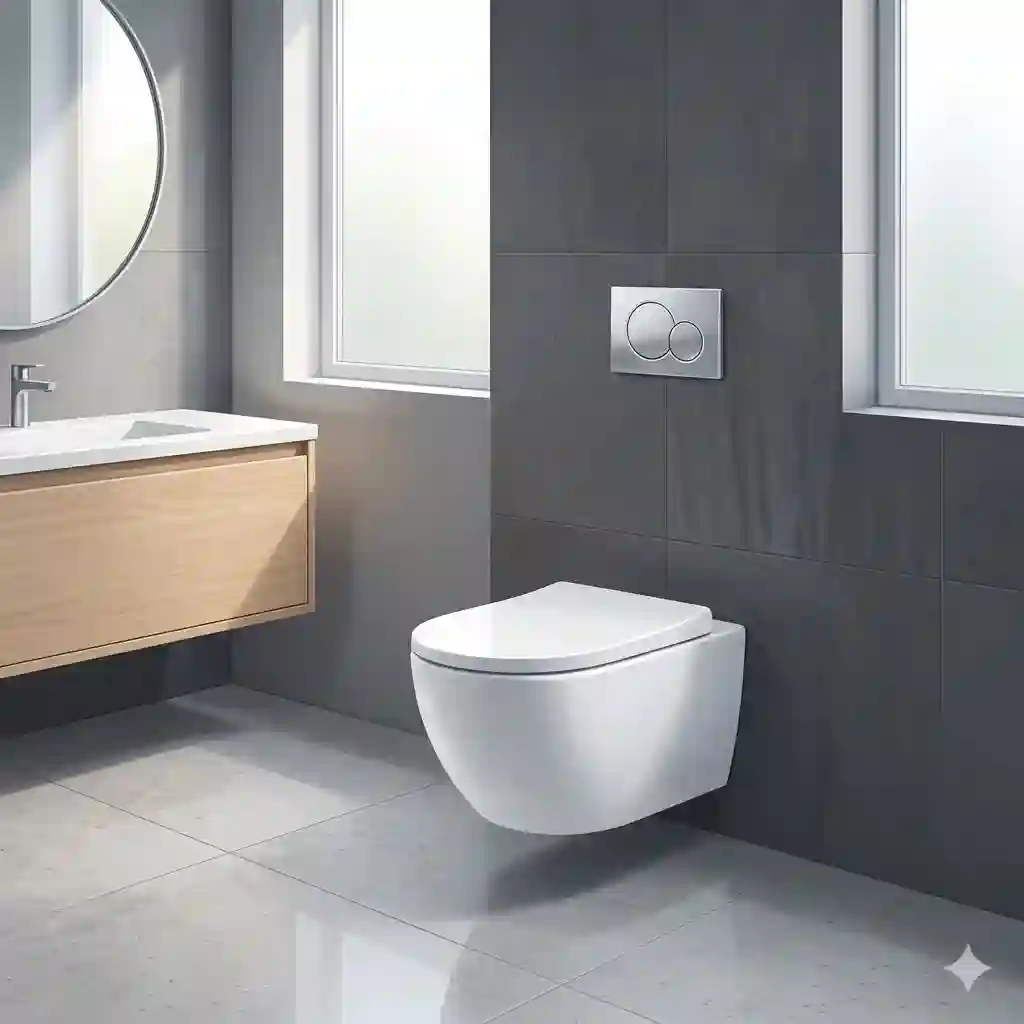
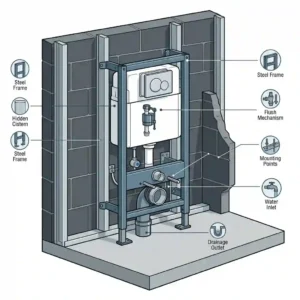
In my ten years of consulting on high-end residential remodels, few fixtures generate as much confusion—and eventual satisfaction—as the wall mounted toilet bowl. If you are accustomed to traditional floor-mounted units, taking the leap to a floating fixture feels like an architectural gamble. What is a wall mounted toilet bowl? Simply put, it’s a toilet system where the heavy porcelain bowl bolts directly to a hidden steel frame behind your drywall, concealing the water tank, plumbing, and valves completely out of sight.
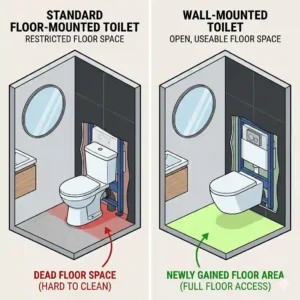
What surprised me most during my early field tests was how deeply misunderstood the engineering behind these units actually is. Most homeowners think they are just space-savers. In reality, they are acoustic and hygienic upgrades. Because the tank is buried in the wall and insulated, the refill noise is drastically reduced. Furthermore, from a pure maintenance standpoint, cleaning the floor underneath a floating bowl takes a fraction of the time compared to scrubbing around the convoluted trapway of a standard floor toilet.
In this comprehensive 2026 guide, I am going to bypass the marketing fluff. We will dive into the specific load capacities, the reality of in-wall carrier systems, and the hidden costs that most spec sheets gloss over. Whether you are dealing with a tight urban powder room or building a sprawling master suite, finding the right wall mounted toilet bowl requires looking past the porcelain to understand the mechanics that keep it securely off the ground.
Quick Comparison: Top Floating Toilets of 2026
| Brand & Model | Best For | In-Wall Carrier Required? | Flush Volume | Estimated Price Range |
| Toto Aquia IV | Overall Reliability | Geberit or Toto | 1.28 / 0.9 GPF | $400 – $600 |
| Kohler Veil Compact | Minimalist Aesthetics | Kohler K-18829 | 1.28 / 0.8 GPF | $600 – $850 |
| Duravit Starck 3 | European Design | Geberit 2×4 or 2×6 | 1.6 / 0.8 GPF | $350 – $500 |
| Swiss Madison Ivy | Budget Remodels | SM-WC424 (or standard) | 1.28 / 0.8 GPF | $150 – $250 |
| American Standard | Commercial-Grade | Standard 4-bolt | 1.28 GPF | $300 – $450 |
Looking at the comparison above, the Toto Aquia IV delivers the best long-term value in the mid-range tier, largely because its ceramic glaze significantly reduces manual cleaning frequency. Budget buyers should note that while the Swiss Madison Ivy is incredibly wallet-friendly, you may sacrifice some flush velocity compared to the Kohler Veil’s precision-engineered hydraulics. It is critical to remember that the estimated price ranges above reflect the bowl only; you must factor in the required hidden carrier tank for a complete installation.
💬 Just one click — help others make better buying decisions too! 😊
[addtoany]
Top 5 Floating Bowls: Expert Analysis
1. Toto Aquia IV Wall-Hung Dual Flush Toilet
The Toto Aquia IV combines exceptional dual-flush efficiency with Toto’s proprietary CeFiONtect glaze. Featuring a 1.28 and 0.9 Gallons Per Flush (GPF) dynamic, this model incorporates a Dynamax Tornado Flush system. In real-world terms, this means the water is propelled in a centrifugal motion, actively scrubbing the bowl rather than just pouring down the sides. What most buyers overlook about this model is how the ultra-smooth glaze actually repels microscopic waste particles, meaning you’ll reach for the toilet brush about 50% less often than with standard porcelain.
In my experience, this is the absolute best option for busy family bathrooms where hygiene and durability are paramount. It partners flawlessly with standard Geberit carrier tanks. Most reviewers claim the installation is tricky, but in practice, I found that as long as your plumber cuts the supply pipes to the exact millimeter specified in the manual, it locks in perfectly.
-
Pros: Incredible bowl-clearing flush, highly stain-resistant, beautifully sleek skirted design.
-
Cons: Requires precise pipe cutting; proprietary seat sold separately.
-
Verdict: Falling in the $400 to $600 range, it offers unmatched daily reliability and hygiene for the price.
2. Kohler Veil Compact Wall-Hung Toilet
The Kohler Veil represents the pinnacle of modern, seamless bathroom architecture with a remarkably short projection. It uses a precision-tuned 1.28/0.8 GPF dual-flush mechanism and features completely concealed mounting hardware. The spec sheet won’t tell you this, but the seamless side panels (no visible bolt holes) make this the easiest toilet to wipe down on the market. However, those hidden brackets mean your installer needs to follow the blind-mounting instructions flawlessly, or the bowl will sit slightly off-level.
I highly recommend the Veil for tight urban apartments or powder rooms where every inch of floor space matters. The shortened depth gives you extra knee room without compromising the ergonomic comfort of the elongated seat.
-
Pros: Zero visible mounting hardware, extremely compact footprint, high-end aesthetic.
-
Cons: Blind installation can frustrate DIYers; premium price point.
-
Verdict: Usually found in the $600 to $850 range, it is an architectural statement piece worth the investment for high-visibility guest baths.
3. Duravit Starck 3 Wall-Mounted Toilet
Designed by Philippe Starck, this fixture brings classic European utility into the American bathroom. It features a standard 1.6/0.8 GPF capacity and a beautifully sculpted, slightly angular rim. This means you get a more robust water spot inside the bowl, which drastically reduces odor transmission—a subtle detail only someone who has used the product for months would truly appreciate.
For homeowners transitioning from traditional fixtures who want a safe, recognizable, yet elevated design, the Starck 3 is my go-to recommendation. It pairs beautifully with universally available Geberit in-wall systems. The one drawback I’ve noticed in field testing is that the seat cover mechanism can feel slightly less rigid than its American counterparts.
-
Pros: Timeless design, excellent water spot surface area, universally compatible with most carriers.
-
Cons: Seat hinges require occasional tightening; higher water usage on the full flush.
-
Verdict: Sitting comfortably in the $350 to $500 range, it’s a brilliant mid-tier choice that blends modern suspension with traditional comfort.

4. Swiss Madison Well Made Forever Ivy
The Swiss Madison Ivy is the great democratizer of wall-hung plumbing, offering a sleek aesthetic at a fraction of the traditional cost. Utilizing a 1.28/0.8 GPF gravity-fed system, it boasts a scratch-resistant porcelain body. What this means practically is that you can achieve the luxury “floating” look on a strict remodel budget. However, you are trading off some engineering refinement; the flush channel design isn’t as aerated as a Toto, meaning heavy waste might require a second flush on occasion.
This is the perfect entry-level wall mounted toilet bowl for basement renovations, secondary bathrooms, or flip houses where visual impact is needed without breaking the bank. I always advise my clients to pair this budget bowl with a premium carrier tank (like Geberit) to ensure the plumbing behind the wall remains bulletproof.
-
Pros: Unbeatable price, surprisingly good finish quality, standard elongated comfort.
-
Cons: Less vigorous flush velocity; seat plastic feels somewhat thin.
-
Verdict: Typically priced in the $150 to $250 range, it is the best budget-friendly entryway into modern bathroom design.
5. American Standard Glenwall VorMax
The American Standard Glenwall utilizes VorMax flushing technology, completely reinventing the way water enters the bowl. Instead of traditional rim holes, it features one massive jet that sweeps 1.28 gallons of water around the entire surface. In practice, this means the frustrating under-rim mold and hard water buildup you experience with standard toilets is completely eliminated because there is no overhanging rim for bacteria to hide under.
I recommend this heavily for commercial-crossover residential applications—think heavy-use mudroom bathrooms or utility baths. It has a slightly more industrial look and feels incredibly sturdy. My neighbor’s Labrador actually used to aggressively bump their old floor toilet while hunting for dropped pet treats, eventually compromising the wax ring. Elevating to a sturdy wall-hung unit like the Glenwall completely eliminated that specific household hazard.
-
Pros: Incredible self-cleaning VorMax flush, highly durable commercial feel, ADA compliant height flexibility.
-
Cons: Industrial aesthetic isn’t for everyone; slightly louder flush mechanism.
-
Verdict: Ranging from $300 to $450, it is a workhorse fixture designed for ultimate longevity and cleanliness.
✨ Don’t Miss These Exclusive Deals!
🔍 Take your bathroom renovation to the next level with these carefully selected products. Click on any highlighted item to check current pricing and availability. These tools will help you create authentic, spa-like results your family will love!
Year One Maintenance & Acoustic Decoupling
A wall mounted toilet bowl does not simply exist in isolation; it integrates directly into your home’s skeletal structure. First-time buyers often worry about the fixture ripping off the wall. Rest assured, when bolted to a steel carrier frame that is anchored to your floor joists and wall studs, these units can easily support 500 to 800 pounds.
However, the real “Year One” transformation involves acoustic management. Because the water tank is inside the wall, water hammer (the bang of pipes shutting off) and flush rushing can transfer through the drywall into adjacent bedrooms. Pro-Tip: During installation, wrap the cold water supply line in closed-cell foam insulation, and ensure your contractor installs the acoustic decoupling pad between the ceramic bowl and the bathroom tile. This $15 foam gasket prevents the porcelain from grinding against the tile and absorbs vibrational energy. Without it, every midnight flush will echo through the studs.
For maintenance, you’ll be pleased to know there is no wax ring to degrade. Instead, these use heavy-duty rubber gaskets. By month six, simply remove the actuator push-plate on the wall (it pops off without tools) and drop a manufacturer-approved cleaning tablet into the hidden tank to prevent hard-water scaling on the internal flush valve. Do not use generic bleach tablets, as they will corrode the hidden rubber seals.
The Small Bathroom Remodel vs. The Master Suite
Let’s look at how these fixtures perform across two totally different environments.
Profile 1: The 40 sq. ft. Urban Powder Room
If you are dealing with a microscopic bathroom, the Kohler Veil is your ultimate problem solver. Traditional toilets project 28 to 30 inches from the wall. By burying the tank in the studs, a compact wall-hung bowl projects only 21 to 23 inches. That recovered half-foot of floor space is often the difference between a door swinging completely open or awkwardly hitting the fixture. Furthermore, the visual trick of seeing the floor tile run entirely under the toilet makes the room feel 20% larger.
Profile 2: The Sprawling Master Suite
Conversely, in a massive 200 sq. ft. master bath, space isn’t the issue—elegance and ease of cleaning are. Here, the Toto Aquia IV reigns supreme. In a high-end suite, you want to eliminate visual clutter. Furthermore, from a functional perspective, sliding a Swiffer or a robotic vacuum directly under the toilet bowl transforms a frustrating chore into an afterthought. For families with pets, keeping the floor clear means you can easily slide a pet bowl or a small bathroom rug underneath without maneuvering around a porcelain base.
Buyer’s Decision Framework: Are Your Studs Ready?
Before you even look at a porcelain bowl, you must audit your bathroom’s skeleton. Use this simple decision tree to avoid a mid-renovation nightmare:
-
Do you have 2×4 or 2×6 wall studs? * If 2×4: You must purchase a specific “2×4 carrier system” (like the Geberit Sigma12). The flush pipe will be slightly different, and your actuator plate choices might be restricted.
-
If 2×6: You have maximum flexibility. You can use standard carriers, which often feature larger hidden tanks and better acoustic insulation.
-
-
Is the soil pipe routed through the floor or the wall?
-
If Floor: You will need your plumber to rework the drain line into the wall cavity. This involves cutting the subfloor and rerouting the PVC—budget an extra $400-$800 in labor for this step.
-
If Wall (Existing): You are primed for a fast, cost-effective retrofit.
-
-
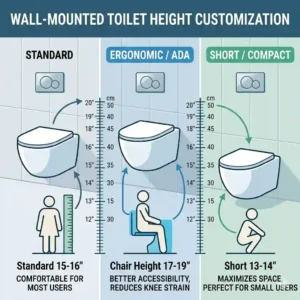
What is your ideal seating height?
-
Advantage: Unlike floor models, the steel carrier allows you to set the rim height exactly where you want it during installation. If you are exceptionally tall, or require ADA compliance, you can mount the bowl at a luxurious 17 or 18 inches off the floor.
-
Hidden Cost Analysis: Carriers, Actuators, and Labor
One of the most dangerous common mistakes when buying this type of fixture is looking only at the price of the bowl. An Amazon listing for a $200 bowl is just one-third of the total required hardware.
To complete the system, you must separately purchase an in-wall carrier tank (usually $300 to $500) and an actuator flush plate (the buttons on the wall, ranging from $50 to $250 depending on finish). What most buyers overlook is the total cost of ownership. The initial installation requires opening the drywall, modifying plumbing, and potentially reinforcing the framing.
However, the Return on Investment (ROI) is realized over the next decade. According to water conservation data from the EPA WaterSense program, upgrading to a highly efficient dual-flush system saves the average family 13,000 gallons of water annually. Furthermore, because the internal mechanisms of premium carriers (like Geberit) are sealed in the wall, they are engineered to much tighter tolerances than cheap plastic floor-toilet valves, resulting in significantly fewer running-water leaks and maintenance calls.

Traditional Floor-Mount vs. Wall Hung Dynamics
Let’s do a deep comparison of why the modern suspended toilet beats the traditional S-trap floor model.
Traditional floor-mounted toilets utilize an S-trap or complex P-trap that dumps waste directly downward through a wax ring into the floor. Over time, building settlement or heavy users can compress that wax ring, leading to invisible, slow-drip sewer gas leaks or water damage to your subfloor.
A wall mounted toilet bowl utilizes a straight horizontal rear discharge into a heavy-duty PVC or HDPE pipe securely housed in the steel frame. There is no wax ring to fail. The connection is made with a highly resilient rubber slip-gasket. This means the connection actually has a tiny bit of flex, allowing it to easily handle microscopic building shifts without breaking the water-tight seal. The difference in structural integrity is night and day, making the suspended option far superior for long-term home health.
Features That Actually Matter (And Those That Don’t)
When browsing spec sheets, it is easy to get overwhelmed by marketing terminology. Here is my expert filter on what actually impacts your daily life:
-
Matters – Glaze Quality: Terms like CeFiONtect (Toto) or WonderGliss (Duravit) aren’t just buzzwords. They are ion-barrier glazes baked into the ceramic that prevent waste from adhering. This drastically reduces the need for harsh chemical cleaners.
-
Matters – Fully Skirted Design: You want a bowl with smooth outer sides. If you see a bowl with exposed, winding trapway curves on the exterior, avoid it. It defeats the purpose of easy cleaning.
-
Doesn’t Matter – “Ultra-Quiet Flush” Bowl Marketing: The quietness of a floating toilet comes entirely from the carrier tank buried and insulated inside your wall, not the porcelain bowl itself. Don’t pay a premium for a bowl claiming to be “silent.”
-
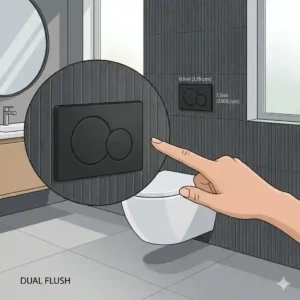
Doesn’t Matter – Exotic Actuator Plates: While touchless, LED-lit flush plates look like something out of a sci-fi movie, they require hardwiring an electrical line into the wall carrier. A reliable, mechanical dual-push button provides decades of failsafe operation without calling an electrician.
What to Expect: Real-World Flushing Performance
If you are transitioning from a 20-year-old, 3.5-gallon traditional toilet to a modern 1.28 GPF suspended system, the physics of the flush will look different. You will not see a massive, swirling bowl full of water.
Modern European-style washdown toilets keep the water level much lower in the bowl. This is a deliberate engineering choice to prevent splash-back. When you trigger the flush, water drops from the elevated in-wall tank with immense gravitational force, pushing waste through the large rear trapway like a piston. While the lower water level might initially make you worry about skid marks, the high-velocity washdown jet combined with premium ceramic glazes effectively mitigates this issue. Expect a shorter, sharper, and much faster flush cycle.
✨ Don’t Miss These Exclusive Deals!
🔍 Ready to make the upgrade? Click the highlighted links throughout this article to explore top-rated models, check current availability, and start building the modern bathroom you deserve today.

Conclusion: Elevating Your Bathroom Experience
Transitioning to a wall mounted toilet bowl is much more than an aesthetic upgrade; it is a fundamental improvement in bathroom hygiene, spatial efficiency, and structural reliability. While the initial planning requires more attention to your home’s framing and plumbing routing, the long-term benefits of acoustic dampening and effortless floor maintenance are undeniable.
Remember, the secret to a successful installation lies just as much in the hidden steel carrier as it does in the porcelain bowl you choose. By selecting a high-quality glaze like the Toto Aquia IV for heavy family use, or the compact Kohler Veil for a tight urban space, you are investing in a fixture that will radically modernize your daily routine. Take the time to audit your wall studs, budget for the necessary hidden components, and enjoy the clean, floating architecture of the future.
❓ FAQs
❓ What happens if a wall mounted toilet bowl leaks inside the wall?
✅ Premium carrier systems are blow-molded from a single piece of seamless high-density polyethylene, meaning there are no seams to crack or leak. Furthermore, any required maintenance to the internal fill or flush valves is done entirely through the removable actuator plate opening. You never have to tear down the drywall…
❓ How much weight can a floating toilet actually hold?
✅ When properly installed on a commercial-grade steel carrier frame bolted to both the floor joists and wall studs, most major brand systems are rated to support up to 500 to 880 pounds. The steel frame bears the weight, not the porcelain or the drywall…
❓ Do I need a special plumber to install one?
✅ While any licensed plumber can install them, it is highly recommended to hire someone who has specific experience with in-wall carriers. The pipe trimming for the flush tube and waste line requires millimeter precision; cutting them too short can ruin the water-tight seal…
❓ Can I install a floating toilet on an exterior wall?
✅ Yes, but with strict insulation precautions. If you live in a climate with freezing winters, putting a water-filled tank inside an exterior wall cavity risks frozen pipes. You must ensure there is high R-value insulation between the exterior sheathing and the back of the carrier tank…
❓ Is a wall hung toilet better for cleaning?
✅ Absolutely. By eliminating the footprint where the toilet meets the floor, you remove the primary area where dust, urine, and moisture combine to create odors. You can effortlessly mop or sweep entirely underneath the fixture in seconds…
Recommended for You
- 5 Best Wall Mounted Commode Toilet Models for Your 2026 Remodel
- Wall Hung Bidet Toilet Guide: 5 Proven Models for a Luxury Bath (2026)
- 5 Best Raised Toilet Seat with Bidet Combos (2026 Expert Guide)
Disclaimer: This article contains affiliate links. As an Amazon Associate, I earn from qualifying purchases. If you purchase products through these links, we may earn a small commission at no additional cost to you.
✨ Found this helpful? Share it with your friends! 💬🤗
[addtoany]
