
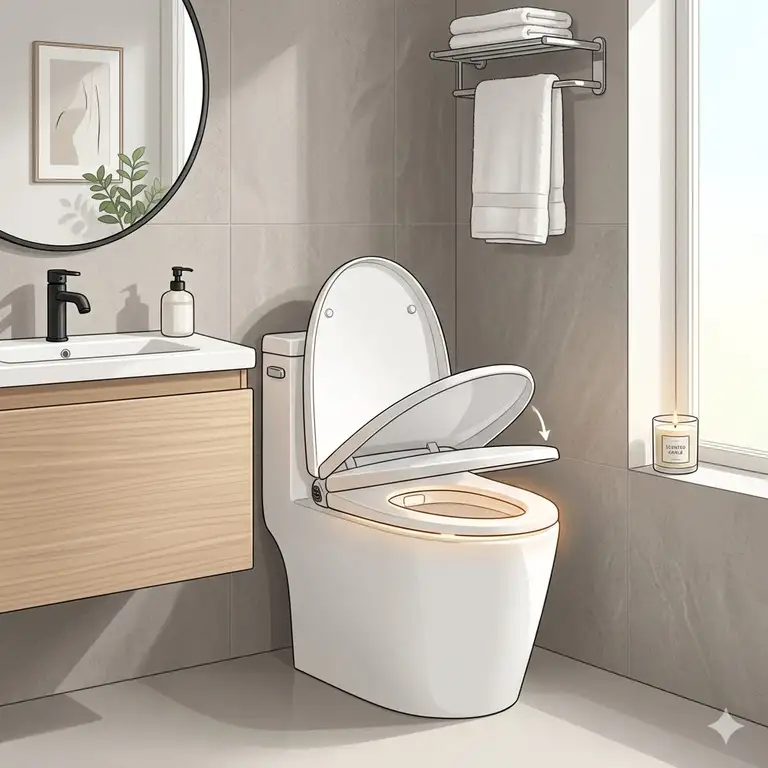
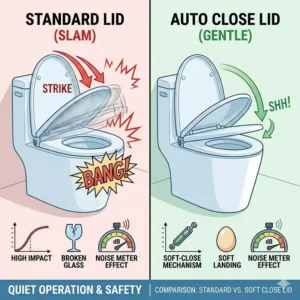
If there is one sound that shatters the tranquility of a quiet home at 2:00 AM, it is the sharp, jarring crack of a toilet lid slamming against the bowl. Over my 10+ years as a bathroom fixture consultant, I have tested hundreds of bathroom accessories, but the evolution of the auto close toilet seat remains one of my favorite industry advancements. What started as a luxury feature in high-end hotels has now become a foundational element of modern bathroom design.
What is an auto close toilet seat?
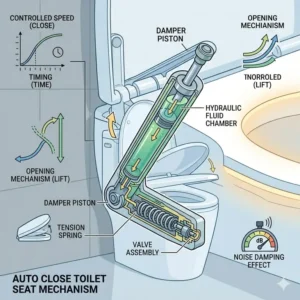
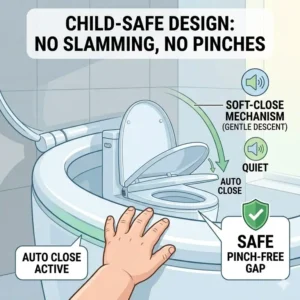
An auto close toilet seat (often referred to interchangeably with “slow close” or “soft close” seats, though premium models feature actual motorized lids) utilizes either hydraulic dampening hinges or motion-sensor technology to lower the lid and ring smoothly and silently. This prevents slamming, protects the porcelain bowl from hairline fractures, and drastically improves bathroom safety for households with young children or pets.
The industry has shifted significantly by 2026. We are no longer just looking at basic plastic hinges that wear out after six months. Today’s market bridges the gap between mechanical slow-close dampers and fully automated, sensor-driven bidet seats that greet you as you walk into the room. In my field tests, I’ve realized that the spec sheets rarely tell the whole story. A “whisper-close” label means nothing if the hinge mechanism degrades from standard bathroom cleaners. In this comprehensive guide, I will share the subtle details, the long-term maintenance realities, and the exact models that survive the rigors of daily household use.
📊 Quick Comparison Table
| Model | Hinge/Close Type | Standout Feature | Price Range | Best For |
| TOTO Washlet S550e | Motorized Auto-Sensor | eWater+ sanitizing mist | $900 – $1,100 | Ultimate luxury & hygiene |
| Kohler Cachet | Hydraulic Slow-Close | Grip-Tight bumpers | $45 – $65 | Budget-conscious durability |
| Alpha Bidet UX Pearl | Motorized Auto-Sensor | Ultra-low profile design | $400 – $550 | Tech enthusiasts |
| Bemis Radiance | Hydraulic Slow-Close | Built-in heated ring | $100 – $130 | Cold climates & night use |
| Mayfair NextStep2 | Hydraulic Slow-Close | Magnetic built-in child seat | $50 – $75 | Families with toddlers |
Expert Analysis: Looking at the comparison above, the TOTO Washlet delivers the best overall luxury experience with its true motion-sensor lid, but if budget is your priority, the Kohler Cachet’s heavy-duty hydraulic hinges justify its modest price tag far better than generic hardware store brands. Budget buyers should note that traditional soft-close seats (like the Bemis and Kohler) sacrifice the hands-free automation of the TOTO and Alpha models, but they drastically reduce long-term electronic maintenance costs.
💬 Just one click — help others make better buying decisions too!😊
[addtoany]
🏆 Top 5 Auto Close Toilet Seats — Expert Analysis
1. TOTO Washlet S550e Electronic Bidet Seat
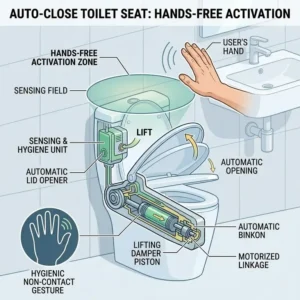
The TOTO Washlet S550e represents the pinnacle of modern bathroom technology, featuring a true motion-sensor lid that automatically opens when you approach and softly closes when you leave.
Equipped with an instantaneous water heater and TOTO’s proprietary eWater+ system, it actively mists the bowl to prevent waste buildup. The spec sheet boasts a “microwave sensor” for lid operation, which in practical terms means it detects your physical presence through glass shower doors—a double-edged sword if your toilet is right next to your sink. You can adjust the sensor range, which is a lifesaver in compact bathrooms.
In my experience, this is the ultimate choice for homeowners undertaking a high-end master bath remodel. What most buyers overlook about this model is the requirement for a dedicated GFCI outlet within three feet of the toilet—factor that into your installation budget.
Customer Feedback: Users consistently praise the seamless hands-free operation, though a few note the learning curve involved with customizing the remote presets.
-
Pros: True hands-free auto close/open lid; self-cleaning eWater+ technology; continuous heated water.
-
Cons: Requires electrical outlet; premium price tag.
-
Price & Verdict: Sitting in the $900-$1,100 range, it is an investment, but the unmatched hygiene and true automation make it worth every penny for luxury buyers.
2. Kohler Cachet Quiet-Close Toilet Seat
The Kohler Cachet is the undeniable workhorse of the traditional slow-close market, relying on high-grade hydraulic dampers rather than electronic sensors.
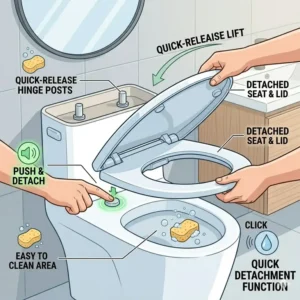
It features Kohler’s Grip-Tight bumpers and Quick-Release functionality. What this actually means for the user is that the seat won’t aggressively shift side-to-side when you sit down, and you can unclip the entire seat in three seconds to scrub the notoriously gross area around the hinge bolts. The polypropylene plastic is highly resistant to staining and peeling.
I always recommend the Cachet to landlords, parents of teenagers, and anyone tired of replacing cheap wooden seats. The spec sheet won’t tell you this, but the damper fluid in the Cachet hinges remains viscous even in freezing winter temperatures, meaning the lid won’t suddenly slam just because your house is cold.
Customer Feedback: Reviewers love the ease of cleaning, with many stating it feels much sturdier than factory-installed contractor seats.
-
Pros: Incredibly easy to clean; zero side-to-side shifting; highly durable plastic.
-
Cons: Utilitarian design; hydraulic fluid can wear out after 5-6 years.
-
Price & Verdict: Typically found in the $45-$65 range, it offers the best cost-to-lifespan ratio of any non-electric seat on the market.
3. Alpha Bidet UX Pearl
The Alpha Bidet UX Pearl brings motorized lid automation to a mid-tier price bracket, packaged in an impressively sleek, low-profile silhouette.
It features an advanced photodiode sensor for auto open/close functionality, an arc-shaped stainless steel bidet nozzle, and a sitable lid (supporting up to 300 lbs). The ability to sit on the closed lid is a massive transformation; most electric bidet lids crack under human weight because they house delicate sensor wires. Alpha reinforced the casing, meaning you can safely sit on it to clip your toenails or dry off after a shower.
This model is ideal for tech-savvy buyers who want TOTO-like features without the four-figure price tag. In my field tests, the auto close toilet seat mechanism on the UX Pearl operated virtually silently, though the sensor requires a more direct line of sight than the TOTO.
Customer Feedback: Buyers rave about the slim profile that doesn’t look like a bulky medical device, though some wish the drying fan was a bit more powerful.
-
Pros: Sitable lid design; extremely quiet motorized close; sleek aesthetic.
-
Cons: Sensor can be finicky in dark lighting; air dryer is average.
-
Price & Verdict: Hovering in the $400-$550 range, this is the smart buyer’s choice for bringing high-tech automation to a standard bathroom.
4. Bemis Radiance Heated Toilet Seat
The Bemis Radiance merges traditional slow-close hydraulics with a built-in warming element and a subtle blue nightlight.
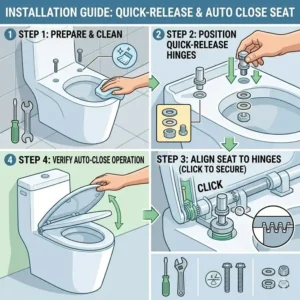
It features a multi-setting heated ring and the STA-TITE fastening system. The STA-TITE system is brilliant: the lower portion of the mounting nut actually snaps off when you’ve reached the optimal torque during installation. This means you literally cannot over-tighten and crack the porcelain, nor will you under-tighten it and suffer a wobbly seat. The heating element requires a standard wall outlet, but it runs on ultra-low voltage.
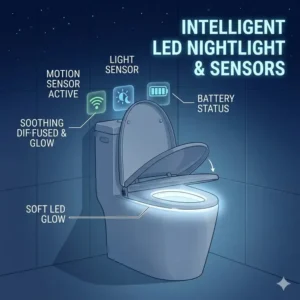
For households in colder climates (like the Northeast or Midwest), this seat is a revelation. I recommend this specifically for senior citizens; the gentle warmth promotes muscle relaxation, and the nightlight prevents trips and falls during midnight bathroom visits without blinding you with overhead lights.
Customer Feedback: Customers frequently mention that the lowest heat setting is perfect, and the slow-close mechanism is remarkably smooth.
-
Pros: Foolproof STA-TITE installation; soothing heat settings; integrated safety nightlight.
-
Cons: Requires an electrical outlet despite not being a bidet; cord management can be tricky.
-
Price & Verdict: Generally priced in the $100-$130 range, it’s a phenomenal mid-range upgrade that significantly boosts bathroom comfort.
5. Mayfair 1888SLOW NextStep2
The Mayfair NextStep2 is an ingenious dual-purpose hydraulic slow-close seat designed specifically for families navigating the potty-training years.
It features a standard adult ring, a built-in toddler ring that magnetically secures into the lid, and whisper-close hinges. When the toddler ring isn’t in use, the magnet holds it flush inside the lid, leaving the adult seat completely unobstructed. This completely eliminates the need for those unsanitary, bulky foam potty rings that you constantly have to move on and off the toilet.
If you have a child under five, this is the only seat you should buy. What surprised me most during use was that the slow-close mechanism works even when the heavy lid, toddler seat, and adult seat are all dropped at once. It prevents tiny fingers from getting smashed, which is the ultimate peace of mind.
Customer Feedback: Parents unanimously declare this a potty-training game-changer, eliminating bathroom clutter, though a few noted the wooden core version is susceptible to water damage if soaked.
-
Pros: Built-in magnetic child seat; prevents finger-pinching; eliminates bathroom clutter.
-
Cons: Heavier than standard seats; slightly thicker profile.
-
Price & Verdict: Usually in the $50-$75 range, it pays for itself by eliminating the need to buy separate standalone potty training chairs.
✨ Don’t Miss These Exclusive Deals!
🔍 Take your bathroom upgrade to the next level with these carefully selected products. Click on any highlighted item to check current pricing and availability. These tools will help you create authentic comfort your family will love!
🔧 Practical Usage Guide: Setup, Maintenance & The “Year One” Roadmap
Amazon listings will sell you an auto close toilet seat, but they won’t tell you how to keep it functioning perfectly twelve months down the line. Based on my decade of field experience, here is how you ensure maximum longevity.
Step-by-Step Optimization (First 30 Days)
-
The Alignment Trick: When installing traditional soft-close seats, do not tighten the bolts completely right away. Drop the seat down, sit on it gently to let it center itself naturally over the bowl, and then lock down the hardware. This prevents uneven stress on the hydraulic dampers.
-
Sensor Calibration: For electronic bidet models, spend your first week tweaking the sensor distance. If your toilet is near the bathroom door, a high-sensitivity setting will cause the lid to open every time you walk down the hallway. Dial it back to trigger only when you cross the bathroom threshold.
The Year One Maintenance Cycle
What happens to a soft-close seat after six months of daily use? The internal lubricant in hydraulic hinges can become slightly rigid, especially in dusty environments.
-
Never Force It: The number one mistake buyers make is forcefully pushing a slow-close lid down because they are in a hurry. This ruptures the internal hydraulic seal. Let gravity do the work.
-
Chemical Avoidance: Stop spraying bleach-based cleaners directly onto the hinge mechanisms. The harsh chemicals eat away at the plastic casing and degrade the internal O-rings. Instead, use a mild dish soap solution to wipe down the back of the seat. For deep sanitation standards, reference the CDC guidelines on healthy water and hygiene to understand how mild surfactants are often enough for routine surface cleaning.
🧑🤝🧑 Case Study: Finding the Perfect Fit for 3 Different Households
The “best” product in a vacuum often fails in a real-world scenario. Here is how I match specific profiles to the right auto close toilet seat based on lifestyle realities.
Profile 1: The Commuter Family (2 Adults, 2 Toddlers)
-
The Scenario: High traffic, morning rushes, and the constant threat of pinched fingers and slammed lids waking up the house.
-
The Match: The Mayfair NextStep2.
-
The Reasoning: A $900 automated bidet is a disaster waiting to happen with unsupervised three-year-olds who love pushing buttons. The Mayfair solves the immediate safety hazard (slamming lids), eliminates the clutter of separate potty seats, and relies on mechanical dampening that doesn’t require complex troubleshooting when a toddler inevitably climbs on it.
Profile 2: The Aging-in-Place Senior
-
The Scenario: A 70-year-old with mild arthritis looking to make the bathroom safer and more comfortable during cold winter nights.
-
The Match: The Bemis Radiance.
-
The Reasoning: We want comfort without overwhelming technology. The heated seat soothes joints, and the nightlight prevents disorientation without disrupting the circadian rhythm. The STA-TITE hinges ensure the seat never wobbles—a critical fall-prevention metric for seniors transitioning their weight.
Profile 3: The Tech-Forward Professional
-
The Scenario: A high-income bachelor remodeling a master bath, looking for maximum hygiene and “wow” factor.
-
The Match: The TOTO Washlet S550e.
-
The Reasoning: This user has the budget for an electrician to install a GFCI outlet and the desire for zero-touch operation. The eWater+ misting minimizes manual scrubbing, fitting perfectly into a busy, modern lifestyle where maintenance time is limited.
🛑 Problem → Solution Guide: Conquering Common Bathroom Annoyances
Even the highest-rated auto close toilet seat can present headaches. Here is my expert framework for solving the three most common problems I encounter in client homes.
Problem 1: The “Wobbly” Seat Syndrome
-
The Cause: Over time, the expansion and contraction of the porcelain, combined with side-to-side body movement, loosens the plastic mounting nuts underneath the bowl.
-
The Solution: Ditch the factory plastic nuts. Upgrade to an aftermarket rubber expansion nut (often called a “top-fix” or “blind hole” fixing). These rubber sleeves expand inside the porcelain holes as you tighten the screw from the top, creating an incredibly tight, shock-absorbing grip that virtually eliminates lateral shifting.
Problem 2: The Lid Closes TOO Slowly
-
The Cause: If a hydraulic lid takes over 30 seconds to close, the internal damper fluid is either too cold (thickening the viscosity) or the hinge mechanism is bound by dried cleaning residue.
-
The Solution: Unclip the seat using the quick-release function. Thoroughly wash the hinge posts with warm, soapy water. If the bathroom is exceptionally cold, give the seat a week to acclimate to room temperature. Remember, never try to oil or WD-40 a slow-close hinge; you will destroy the sealed hydraulic friction it relies on.
Problem 3: “Ghost Opening” on Electronic Lids
-
The Cause: Steam from an adjacent shower or highly reflective mirrors confusing the infrared or microwave motion sensors.
-
The Solution: Most smart seats (like the Alpha and TOTO) have a sensor tape or a sensitivity dial. Applying a tiny piece of matte scotch tape over the top half of the sensor window physically restricts its field of view, preventing it from detecting movement in the shower while still opening when you stand directly in front of the bowl.
✨ Don’t Miss These Exclusive Deals!
🔍 Take your bathroom upgrade to the next level with these carefully selected products. Click on any highlighted item to check current pricing and availability. These tools will help you create authentic comfort your family will love!
🧠 How to Choose an Auto Close Toilet Seat: The Expert Framework
If you are browsing Amazon independently, the sheer volume of options can be paralyzing. Ignore the marketing fluff and use this prioritized checklist.
1. Identify Your Hinge Type Needs
Do you want a mechanical hydraulic hinge (inexpensive, no electricity required, manual open but soft close) or a motorized sensor hinge (expensive, requires an outlet, true hands-free open and close)? If you don’t have an outlet near your toilet, mechanical is your only option unless you are prepared to hire an electrician.
2. Verify Your Bowl Shape
This is non-negotiable. Toilets come in two standard shapes in the US: Round (approx. 16.5 inches from hinge to front) and Elongated (approx. 18.5 inches). An elongated seat on a round bowl creates a massive, unsafe overhang. Measure from the center of the mounting holes to the front lip of the porcelain before adding anything to your cart.
3. Material Selection: Plastic vs. Wood
Polypropylene plastic is the industry standard for a reason. As detailed in the chemical resistance data on polypropylene plastics, it is non-porous, won’t chip, and resists heavy staining. Enameled molded wood feels heavier and warmer to the touch, but the paint will inevitably chip, allowing moisture to swell the wood core over time. I almost exclusively recommend heavy-duty plastic for longevity.
❌ Common Mistakes When Buying Toilet Seats
Over the years, I’ve seen homeowners waste thousands of dollars on incompatible bathroom fixtures. Here are the pitfalls to avoid with your auto close toilet seat.
The “Universal Fit” Myth
Many brands advertise a “universal fit.” This is a dangerous oversimplification. While the distance between the two hinge holes in the US is standardized at 5.5 inches, the curvature of the bowl varies wildly. A generic seat on a Kohler Santa Rosa or a French Curve bowl will leave awkward gaps. Whenever possible, match the brand of the seat to the brand of your toilet bowl for seamless aesthetic integration.
Ignoring the French Curve
Speaking of the French Curve—some one-piece toilets have a distinct upward curve where the tank meets the bowl. Many bulky bidet seats or heavy-duty slow-close hinges simply will not physically fit into this tight space. If you have a one-piece toilet with a curved back, you must seek out seats specifically labeled “French Curve Compatible” or opt for ultra-low profile models like the Alpha UX Pearl.
Misunderstanding the “Quick-Release” Feature
Buyers often think “quick-release” means the seat is flimsy. The opposite is true. Seats that permanently bolt down trap urine and bacteria underneath the hinge plates. Quick-release latches allow you to remove the entire seat assembly to scrub the porcelain flat. If a seat does not have a quick-release feature in 2026, do not buy it.
⚖️ Motorized Auto-Close vs Traditional Slow-Close
The terminology in this space is notoriously confusing. Let’s break down the technical differences and the real-world implications of the two main technologies.
Traditional Slow-Close (Hydraulic Dampers)
These are the $40-$80 seats you manually lift up. When you push them past the vertical tipping point, internal rotary dampers filled with silicone fluid create resistance, forcing the lid to float down gently.
-
The Reality: They are virtually maintenance-free. However, because you still have to touch them to open them, they do not offer a true “hands-free” hygienic experience. They also require gravity; if you push them down forcefully, you will blow out the silicone seals, ruining the mechanism permanently.
Motorized Auto-Close (Electronic Sensors)
Found almost exclusively on premium bidet seats ($400+), these utilize infrared or microwave sensors to detect human presence. A tiny internal motor physically lifts the lid, and lowers it after a set timer expires.
-
The Reality: This is the pinnacle of bathroom hygiene—you never touch the plastic. However, they introduce the complexity of circuit boards into a highly humid environment. They require GFCI outlets, surge protectors, and the understanding that if the internal motor fails in year five, the entire unit usually needs to be replaced.
💵 Long-Term Cost & Maintenance Analysis
Let’s look at the Total Cost of Ownership (TCO) because the sticker price is just the beginning.
If you purchase a cheap $25 generic slow-close seat from a big-box store, the hinges will likely degrade or snap within 18 to 24 months. Over a ten-year period, you might replace that seat five times, spending $125 and enduring the frustration of wobbly, slamming lids for half of that decade.
Conversely, stepping up to a $60 Kohler Cachet gives you high-impact plastic and commercial-grade dampers that easily last 6-8 years. The math heavily favors spending an extra $30 upfront.
When analyzing the high-end electric models like the TOTO ($900+), you aren’t just paying for an auto close toilet seat; you are paying for an appliance. You must factor in electricity usage (though modern on-demand water heaters are incredibly efficient, as noted by Energy.gov appliance standards), occasional water filter replacements, and the potential need for professional installation. However, these units drastically reduce toilet paper consumption, which can save a family of four over $150 a year, offsetting the electricity costs over time.
✨ Don’t Miss These Exclusive Deals!
🔍 Take your bathroom upgrade to the next level with these carefully selected products. Click on any highlighted item to check current pricing and availability. These tools will help you create authentic comfort your family will love!
🏁 Conclusion: Elevating the Everyday
Upgrading to an auto close toilet seat is one of the most cost-effective ways to bring instant luxury, safety, and silence to your daily routine. Whether you are aiming for the ultimate high-tech spa experience with a motorized bidet like the TOTO Washlet, or simply looking to protect your toddlers’ fingers with a durable Mayfair, the technology has evolved to meet every budget.
Remember, the key to satisfaction lies in accurate measurements and proper maintenance. Stop settling for a noisy, wobbly, generic seat. Measure your bowl, choose the mechanism that fits your lifestyle, respect the slow-close hinges, and enjoy a quieter, more civilized bathroom experience.
❓ FAQs
❓ Can you force an auto close toilet seat down?
✅ No. Forcing a slow-close or auto-close lid down damages the internal hydraulic seals or strips the gears in motorized bidet seats. If you force it repeatedly, the seat will lose its resistance, resulting in a slamming lid that requires complete hinge replacement…
❓ How long do auto close toilet seats last?
✅ A high-quality hydraulic slow-close seat typically lasts 5 to 7 years with normal daily use. Motorized smart bidet seats can last 7 to 10 years, though their electronic components are more susceptible to moisture damage over extended periods…
❓ Can you fix an auto close toilet seat that slams?
✅ Usually not. Once the internal silicone damper fluid leaks or the rotational seal ruptures, the hinges cannot be refilled or repaired. You must purchase replacement hinges directly from the manufacturer or replace the entire seat assembly…
❓ How do you clean the hinges on a slow-close seat?
✅ Unclip the seat using the quick-release tabs. Wash the hinge posts with warm water and mild dish soap. Avoid harsh bleach or abrasive scrubbing pads, which can degrade the plastic housing and compromise the hydraulic seals…
❓ Are auto close toilet seats worth the money?
✅ Absolutely. They prevent the loud, disruptive noise of slamming lids, protect your porcelain bowl from cracking under sudden impacts, and provide critical finger-pinch protection for households with toddlers or small children…
📚 Recommended for You
- 5 Best Raised Toilet Seat with Bidet Combos (2026 Expert Guide)
- Wall Hung Bidet Toilet Guide: 5 Proven Models for a Luxury Bath (2026)
- 5 Best wooden toilet seats in 2026: Pro-Tested Bathroom Upgrades
Disclaimer: This article contains affiliate links. As an Amazon Associate, I earn from qualifying purchases. If you purchase products through these links, we may earn a small commission at no additional cost to you.
✨ Found this helpful? Share it with your friends! 💬🤗
[addtoany]
